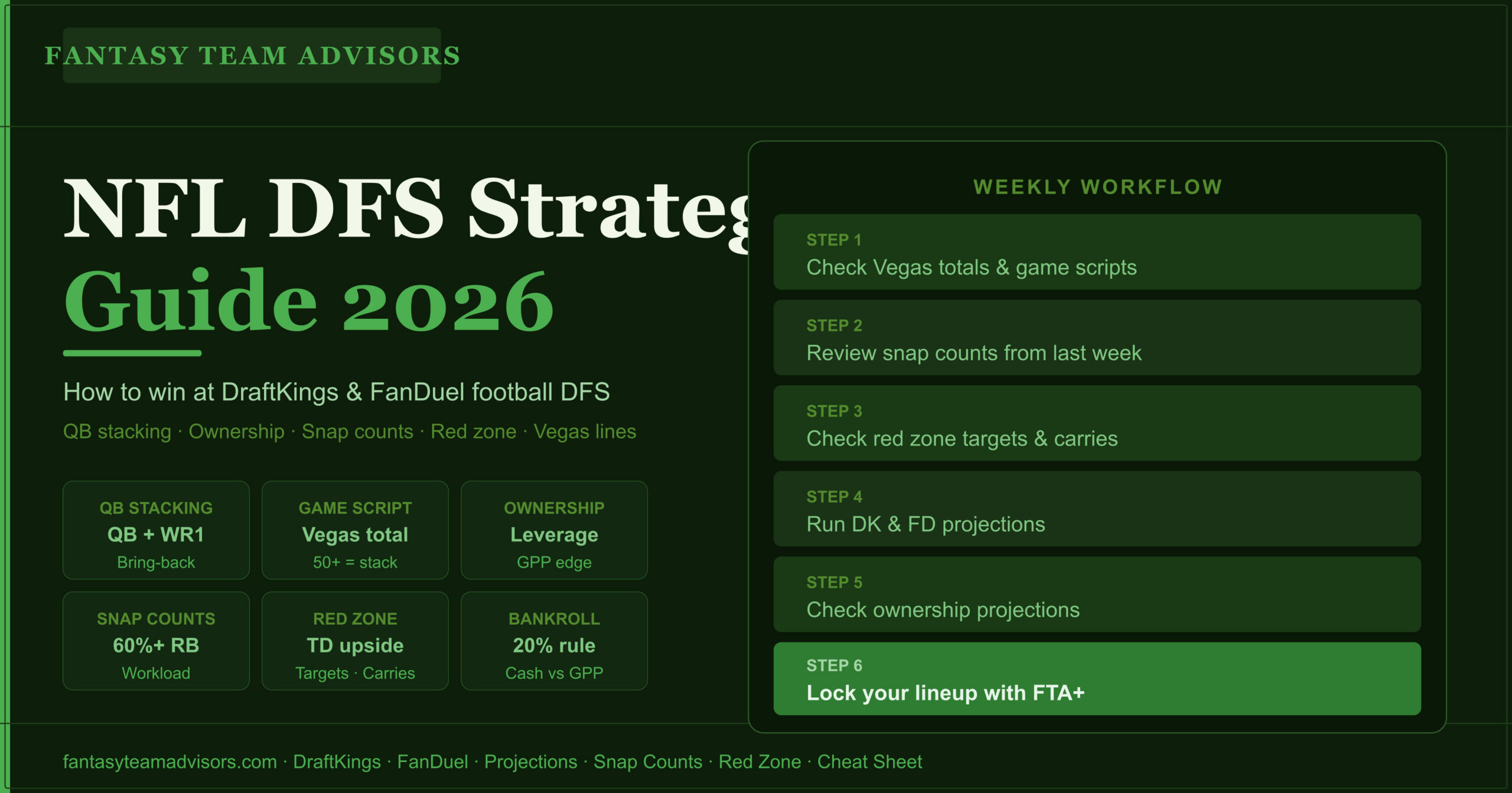
NFL is the most popular DFS sport in America, and for good reason — every week brings massive prize pools, clear matchup edges, and the kind of explosive individual performances that can win you a life-changing payout from a single lineup. But NFL DFS is also brutally competitive. At Fantasy Team Advisors, we’ve been publishing NFL DFS picks and building projection tools since 2014. This guide covers everything you need to win — from lineup construction and quarterback stacking to ownership strategy, Vegas lines, snap counts, red zone targets, weather, and bankroll management.
NFL DFS basics · QB stacking · Position strategy · Game script & Vegas · Ownership strategy · Snap counts & targets · Red zone stats · Weather · Contest selection · Bankroll management · DraftKings vs FanDuel · FTA tools · FAQ
NFL DFS basics — how it works
In NFL DFS on DraftKings and FanDuel, you build a lineup of real NFL players within a salary cap. Players earn fantasy points based on their real-game performance that week. Whoever builds the highest-scoring lineup in their contest wins.
DraftKings NFL lineup requirements
- 1 quarterback (QB)
- 2 running backs (RB)
- 3 wide receivers (WR)
- 1 tight end (TE)
- 1 flex spot (RB/WR/TE)
- 1 defense/special teams (DST)
- Salary cap: $50,000
FanDuel NFL lineup requirements
- 1 quarterback (QB)
- 2 running backs (RB)
- 3 wide receivers (WR)
- 1 tight end (TE)
- 1 flex spot (RB/WR/TE/K)
- 1 defense/special teams (DST)
- Salary cap: $60,000
The key structural difference: DraftKings uses full-point PPR scoring (1 point per reception), while FanDuel uses half-point PPR (0.5 points per reception). This means pass-catching running backs and slot receivers are worth slightly more on DraftKings, while touchdown-dependent players are relatively more valuable on FanDuel. FTA builds separate projection models for each platform to account for this.
QB stacking — the foundation of winning NFL GPP lineups
The most important concept in NFL DFS is the quarterback stack. A QB stack means pairing your quarterback with one or more of his pass catchers — most commonly a wide receiver, but sometimes a tight end or even a running back who catches passes out of the backfield. The reason stacking works is correlation: when a quarterback throws for 350 yards and 4 touchdowns, his receivers are the ones catching those passes and scoring those scores. Their fantasy points are directly linked.
The primary QB + WR stack
The most basic and reliable stack in NFL DFS is quarterback plus his top wide receiver. If you believe a quarterback will have a big game, his most targeted receiver is the best way to double down on that outcome. A game where Patrick Mahomes throws for 380 yards and 3 touchdowns likely means his top wideout has 8-10 catches for 100+ yards — both players score heavily.
For tournament play, add a secondary “bring-back” receiver from the opposing team to create a game stack. If you’re stacking QB1 with his WR1, also add an opposing WR or TE from the same game. This way, if the game turns into a shootout — the scenario that produces the highest individual fantasy scores — you have multiple players benefiting from the high-scoring environment.
The game stack (full correlation)
A full game stack is the most aggressive and highest-ceiling approach in NFL DFS GPPs. You identify a game projected to be a high-scoring shootout (Vegas total of 52+) and roster players from both teams: QB + WR1 from one team, plus WR or TE from the opposing team. If the game plays out as a back-and-forth scoring fest, every player in your stack is scoring fantasy points simultaneously — which is the only way to win a large-field GPP.
The optimal game stack configuration on DraftKings:
- QB (Team A)
- WR1 (Team A) — primary stack
- WR or TE (Team B) — bring-back
- Fill remaining spots with value plays from other games
When to stack a quarterback
Not every game deserves a full game stack. The best stacking spots combine:
- High Vegas game total — 50+ points expected means both teams need to score
- Favorable game script — a game projected to be close keeps both teams throwing
- Pass-heavy offenses on both sides — teams that throw 35+ times per game produce more DFS points
- Weak opposing secondary — the opposing defense allows a high yards-per-attempt and completion percentage
- No weather concerns — wind and cold suppress passing game production significantly
Use our NFL Vegas odds page to find the highest-total games each week.
Position-by-position strategy
Quarterback
Quarterbacks score the most fantasy points of any position in a big game — a 350-yard, 4-TD performance can score 40+ DraftKings points. But quarterbacks are also the most expensive players on the slate, so choosing correctly is essential for roster construction.
The best NFL DFS quarterbacks combine: high passing volume (30+ attempts), a favorable matchup (weak pass defense, high implied game total), and a game script projected to remain close or become a shootout. Avoid quarterbacks in projected blowouts — a QB winning 35-7 stops throwing after halftime.
In cash games, pay for an elite QB in the best matchup. In GPPs, pivot quarterbacks are often the key to differentiation — a QB projected at 20% ownership in a sneaky good matchup gives you leverage if he goes off.
Running back
Running backs are the most volatile position in NFL DFS. The gap between a lead back who gets 25 carries and scores twice (40+ DK points) and a committee back who splits carries and gets 10 touches is enormous. The key is identifying workload — backs who get 70%+ of their team’s carries and see 4-6 targets in the passing game are your cash game anchors.
Use our NFL snap counts tool to verify which backs are truly the lead back on their team. Snap count data from the previous 3-4 weeks is the best predictor of backfield workload going forward.
For GPPs, contrarian running backs — backs with low ownership in good spots — are among the highest-leverage plays in NFL DFS. A 5% owned RB who hits 35 DK points wins you a GPP.
Wide receiver
Wide receivers are the deepest position in NFL DFS and where the most value can be found. Target share is the most important stat — receivers who see 25%+ of their team’s targets have the most consistent opportunity. Combine high target share with a favorable matchup (weak cornerback or safety coverage) and a high-volume passing offense for your top WR plays.
In your QB stack, always prioritize your quarterback’s most targeted receiver. In the flex spot, look for slot receivers in pass-heavy offenses or deep threats in favorable weather and matchup conditions.
Tight end
Tight end is the most position-scarce spot in NFL DFS. Elite tight ends like Travis Kelce have historically been worth their premium salary because the position is so top-heavy. The gap between the top-5 tight ends and the rest of the field is larger than any other position.
In GPPs, tight end is often where you find differentiation. If the field is heavily concentrated on the chalk TE, pivoting to a second-tier TE in a great matchup at lower ownership can be the difference in a tournament lineup.
Defense/Special Teams (DST)
DST is the most volatile position in NFL DFS. A team’s defense can score 30+ points in a blowout or score 0 in a close game. The best DST plays combine: a strong defense facing a weak or turnover-prone offense, low implied points allowed (Vegas projects the opposing offense to score under 18), and home field advantage.
In cash games, pay for an elite DST in the best matchup. In GPPs, value DSTs priced under $3,000 DK in sneaky good spots can save you enough salary to pay up elsewhere.
Game script and Vegas lines — the most underrated NFL DFS edge
Game script refers to how a game unfolds — specifically whether a team is winning or losing and by how much. A team that falls behind by 14 points in the first half will throw the ball 40+ times. A team that jumps out to a big lead will run the ball to kill clock. Game script is the single biggest driver of NFL fantasy production, and Vegas lines give you the best advance signal of how games will play out.
How to use Vegas lines in NFL DFS
Three key Vegas numbers matter most for NFL DFS:
- Game total (over/under) — higher totals mean more scoring, which means more fantasy points distributed across both teams. Target games with totals of 48+ for your stacking games
- Spread (point spread) — large spreads (7+ points) mean one team is projected to win convincingly. The projected loser’s quarterback and pass catchers become more valuable because they’ll be passing to catch up. The projected winner’s running back becomes more valuable late in games when they’re running clock
- Implied team total — derived from the spread and total, this tells you exactly how many points Vegas expects each team to score. Teams with implied totals of 27+ are your primary offensive stack targets
Check current NFL implied totals on our NFL Vegas odds page — updated weekly as lines move.
Line movement as a DFS signal
Pay attention to how totals and spreads move during the week. A game total moving from 47 to 51 between Monday and Sunday means sharp money is indicating a higher-scoring game — possibly due to an injury to a key defender, favorable weather forecast, or both offenses entering the game with momentum. Total movement of 3+ points is a significant DFS signal to increase your exposure to that game’s offensive players.
Ownership strategy — how to win GPPs with leverage
Ownership is the most NFL-specific DFS concept and the one most casual players ignore. In large-field GPPs, knowing which players the field is rostering — and making conscious decisions to be with or against the crowd — is what separates profitable tournament players from the rest.
What is ownership in NFL DFS?
Ownership percentage is the estimated percentage of GPP tournament entries that will roster a given player. A player at 35% ownership appears in 35 out of every 100 lineups. A player at 3% ownership appears in only 3 out of 100.
Cash game ownership strategy
In cash games (50/50s, H2H), ownership doesn’t matter — you’re trying to beat roughly half the field, and the best way to do that is to roster the same high-floor, high-projection players everyone else is playing. In cash games, be the chalk. A player at 40% ownership in a great spot is great for cash games because his production floor is why he’s 40% owned in the first place.
GPP ownership strategy
In GPPs, ownership is everything. The goal is not just to score the most points — it’s to score the most points in a way that most other lineups don’t. A lineup full of 30-40% owned players will rarely win a large GPP even if it scores well, because thousands of other lineups have the same players.
The two approaches to GPP ownership:
- Contrarian — deliberately fade high-owned players in favor of lower-owned players with similar upside. If a 35% owned WR has a sneaky good matchup at 8% ownership, the 8% WR gives you more leverage if both hit. Losing lineups in GPPs are often lineups where the player failed — contrarian lineups where the player hits can leapfrog thousands of opponents simultaneously
- Chalk with differentiation — roster the 1-2 highest-conviction chalk plays but differentiate everywhere else. A chalk QB paired with low-owned receivers from his team and an opposing team can score similarly to the field’s chalk lineup while being structurally different enough to have tournament upside
Use our NFL DraftKings projections and ownership tools to identify chalk vs contrarian plays each week.
Snap counts — the most reliable NFL DFS data point
Snap count data tells you how many offensive plays a player was on the field for. It’s the most reliable indicator of a player’s role and opportunity going into the following week. A running back who played 75% of his team’s offensive snaps last week is the clear lead back. A wide receiver who played 85% of snaps with a 28% target share is a high-volume target regardless of his recent stats.
How to use snap counts in NFL DFS
- Running backs: Lead backs with 60%+ snap share and 4+ targets are your cash game RB anchors. Committee backs splitting 50/50 with a teammate are risky in both cash and GPP
- Wide receivers: Receivers with 80%+ snap share are seeing maximum opportunity. Slot receivers tend to have the highest and most consistent snap shares on their team
- Tight ends: TE snap share of 70%+ combined with 6+ targets per game signals a featured receiving TE worth premium salary
Check our NFL snap counts page — updated weekly after every game with position-by-position breakdown.
Red zone stats — where touchdowns are made or lost
Touchdowns are the highest-value scoring event in NFL DFS. A single touchdown adds 6 points on DraftKings — equivalent to a 60-yard reception. Red zone targets and carries predict which players have the best chance of scoring touchdowns, regardless of their overall stat line.
Key red zone stats for NFL DFS
- Red zone targets (inside 20): Receivers with 2+ red zone targets per game have the highest touchdown upside. Elite red zone targets like the top scoring TEs often see 30%+ of their team’s red zone looks
- Goal-line carries (inside 5): Running backs who handle the bulk of goal-line carries are the most reliable touchdown scorers on their team. A back with 60% of goal-line carries on a team scoring 28+ points per game is a high-floor cash game play
- End zone targets (inside 10): Similar to red zone targets but more specific — end zone targets directly translate to touchdown opportunities
Use our NFL red zone stats tool to identify the highest-volume red zone players each week.
Weather — the biggest wild card in NFL DFS
Weather can completely change your NFL DFS strategy for a given week. Outdoor stadiums in winter months — particularly in cold-weather cities like Green Bay, Chicago, Buffalo, and Kansas City — can see conditions that dramatically suppress passing game production.
Wind
Wind is the most impactful weather factor in NFL DFS. Sustained winds of 20+ mph make deep passing unreliable and significantly reduce quarterback and wide receiver value. In high-wind games, running backs and tight ends (shorter routes, more reliable targets) become relatively more valuable. Total points in windy games tend to go under, so fade offensive players from wind-affected games in favor of DST plays and ground-heavy offenses.
Cold and precipitation
Cold temperatures (below 25°F) reduce ball handling and passing precision. Rain and snow further suppress scoring. Avoid rostering pass-catchers — especially deep threats and receivers with low target counts who depend on big plays — in games with significant precipitation. Running backs gain relative value in poor weather as teams commit to the run.
Dome advantage
Dome teams (Cowboys, Vikings, Saints, Falcons, Colts, Lions, Rams, Chargers) playing at home always have a weather-neutral environment. Dome games are generally higher-scoring than outdoor games in cold weather months. In November and December, dome game stacks carry a built-in edge over outdoor games in hostile weather.
Contest selection — maximizing your ROI in NFL DFS
Slate types
NFL DFS offers several slate types each week, each requiring a different strategy:
- Main slate (Sunday 1pm + 4pm games) — the largest, most competitive slate with the biggest prize pools. Most of your GPP volume should be here
- Early only slate (Sunday 1pm games only) — smaller slate, fewer games, often softer competition. Good for cash games and smaller GPPs
- Sunday night game (SNF) — single-game showdown format. High variance, requires a different roster construction approach
- Monday Night Football (MNF) — single-game showdown. Same approach as SNF showdowns
- Thursday Night Football (TNF) — short week for both teams, often lower-scoring, difficult to project. Be selective with your exposure
Showdown slates (single-game)
Showdown slates on DraftKings and FanDuel require you to build a lineup from just one game, with a captain/MVP multiplier slot that scores 1.5x points. The key to showdown strategy:
- Pick a high-ceiling player as your captain — the QB from the team you project to win, or the top WR in the game
- Build around correlation — stack the same team’s skill players around your captain
- Include a bring-back from the opposing team to benefit from a shootout
- Showdowns are extremely volatile — enter multiple lineups with different captain selections to cover different game script scenarios
Bankroll management — playing NFL DFS for the long run
NFL DFS is a weekly game with high variance. Even the best players lose money in most individual weeks — the edge compounds over a full season. Disciplined bankroll management is what separates players who build wealth from those who blow up after two bad weeks.
The 20% weekly rule
Never risk more than 20% of your total DFS bankroll in any single NFL week. If you have $1,000 in your accounts, your maximum weekly exposure is $200. This ensures that even a catastrophic week — injuries to your key players, weather killing your game stack — can’t wipe out your ability to play the following week.
Cash vs GPP allocation
For most players, a 60/40 split between cash games and GPPs is the right starting point. Cash games provide consistent, sustainable returns. GPPs provide the upside that makes NFL DFS exciting. As you improve, you can gradually shift more toward GPPs — but don’t go more than 70% GPP until you have at least a full season of tracked results showing positive ROI.
Multi-entry strategy
In large main slate GPPs, entering multiple lineups (5-20 entries) with different stacking configurations gives you better coverage. Rather than putting $50 into one lineup in a $5 GPP, consider entering 10 different $5 lineups with different QB/stack combinations. The variance reduction from lineup diversification is significant in NFL DFS where a single injury can ruin a single-entry lineup.
Track everything
Keep a weekly spreadsheet: contest type, entry fee, placement, and payout. Most NFL DFS players dramatically overestimate their win rate until they see the numbers honestly. After a full season of tracking, you’ll know exactly which slate types, contest sizes, and strategies are actually profitable for you.
DraftKings vs FanDuel NFL — key differences
| Stat | DraftKings | FanDuel |
|---|---|---|
| Passing TD | 4 pts | 4 pts |
| Passing yard | 0.04 pts | 0.04 pts |
| 300-yard bonus | +3 pts | None |
| Reception | 1 pt (full PPR) | 0.5 pts (half PPR) |
| Rushing TD | 6 pts | 6 pts |
| Rushing yard | 0.1 pts | 0.1 pts |
| 100-yard rushing bonus | +3 pts | None |
| Receiving TD | 6 pts | 6 pts |
| Receiving yard | 0.1 pts | 0.1 pts |
| 100-yard receiving bonus | +3 pts | None |
| Interception thrown | -1 pt | -1 pt |
| Fumble lost | -1 pt | -2 pts |
The biggest differences: DraftKings uses full-point PPR and awards milestone bonuses for 100-yard and 300-yard performances, which makes high-volume pass catchers and big-game quarterbacks more valuable. FanDuel’s half-PPR scoring makes touchdowns relatively more important — players who score TDs but don’t accumulate yardage are better on FanDuel than DraftKings.
FTA tools for NFL DFS — your weekly workflow
Here’s the optimal pre-slate workflow using FTA’s NFL DFS tools:
- Check Vegas odds and game totals — use our NFL Vegas odds page to identify the highest-total games and projected game scripts for the week
- Review snap counts from last week — use our NFL snap counts tool to confirm roles, identify emerging players, and spot workload changes after injuries
- Check red zone stats — use our NFL red zone stats page to identify the highest-upside touchdown scorers for the week
- Run DraftKings projections — our NFL DK projections rank every player by projected fantasy points, updated throughout the week as injury news and game-time decisions are announced
- Run FanDuel projections — our NFL FD projections apply FanDuel’s half-PPR scoring to give you platform-specific rankings
- Check ownership projections — identify which players are chalk and which are contrarian opportunities for your GPP lineups
- Review today’s picks post — our weekly NFL DFS picks synthesize everything above into specific stack recommendations and value plays
- Review the cheat sheet — our NFL DFS cheat sheet is a quick-reference for your final lineup lock
Get the full FTA edge with FTA+FTA+ gives you early access to NFL picks, premium projection models, ownership data, and exclusive cheat sheets for every sport — everything you need to execute this strategy profitably every week of the NFL season.
NFL DFS strategy FAQ
What is the most important strategy in NFL DFS?
Quarterback stacking is the single most important concept in NFL DFS. Pairing your QB with one or more of his pass catchers creates correlation — when the QB has a big game, his receivers benefit directly. The best winning GPP lineups almost always feature a QB-WR stack from a high-total game. Everything else in your lineup builds around that core stack.
How do I find the best stack in NFL DFS each week?
Identify the game with the highest Vegas total (50+ points) and favorable game script (projected to be a close, high-scoring shootout). Pair the QB from the team you expect to pass more with his most targeted receiver. Add a bring-back receiver or TE from the opposing team to benefit from the shootout scenario. Use our NFL Vegas odds page and NFL DraftKings projections to identify the top stacking spots each week.
Should I play cash games or GPPs in NFL DFS?
Both have a place in a sustainable NFL DFS strategy. Cash games (50/50s, H2H) provide consistent returns and bankroll stability. GPPs provide the high-upside payouts that make NFL DFS exciting. A 60/40 split between cash and GPP is a solid starting point for most players. Track your results in both to see where your edge is strongest.
What does ownership mean in NFL DFS?
Ownership is the percentage of GPP tournament entries that roster a given player. In large-field GPPs, a highly-owned player who hits benefits most lineups equally — so you don’t gain much leverage. A low-owned player who hits gives you massive leverage over the field because very few other lineups have him. Identifying low-owned players in great spots is the key skill in NFL DFS tournament play.
How does weather affect NFL DFS?
Wind (20+ mph) is the biggest weather factor — it suppresses passing games and makes deep throws unreliable. Cold and precipitation further reduce offensive production. In poor weather games, fade pass catchers in favor of running backs, DSTs, and players on dome teams. Always check weather forecasts on Sunday morning before finalizing outdoor game lineups.
Is DraftKings or FanDuel better for NFL DFS?
Both platforms are excellent for NFL DFS. DraftKings uses full-point PPR and milestone bonuses, making high-volume pass catchers and big-game QBs more valuable. FanDuel uses half-PPR, making TDs relatively more important. The optimal lineup differs between platforms, which is why FTA builds separate projections for each. Playing both gives you genuine diversification each week.
What are snap counts and why do they matter in NFL DFS?
Snap counts tell you how many offensive plays a player was on the field for. A RB with 75% snap share is the clear lead back — he has the workload to deliver a big fantasy game. A WR with 85% snap share is seeing maximum target opportunity. Snap count data from the past 3-4 weeks is the most reliable indicator of role and opportunity going forward. Check our NFL snap counts tool every week.
What is a bring-back in NFL DFS?
A bring-back is a player from the opposing team that you add to complement your QB stack. If you’re stacking QB1 + WR1 from Team A, your bring-back is a WR, TE, or RB from Team B. The bring-back benefits from a shootout — if Team B has to score points to keep up with Team A, your bring-back player is accumulating fantasy points in the same game as your primary stack. This is how full game stacks are constructed.
Where to play MLB DFS
Once you’ve got your lineup built using the strategy above, you need
somewhere to play it. FTA covers MLB DFS on both DraftKings and FanDuel —
and for most players, playing on both platforms gives you the best edge
since ownership differs significantly between the two sites.
DraftKings is the better platform for MLB GPP tournaments thanks to its
larger prize pools and two-pitcher roster construction. FanDuel is often
better for cash games due to its half-PPR scoring and single-pitcher format
which rewards consistent contact hitters. If you’re new to DFS or deciding
which site to focus on, read our full breakdown of the
best DFS sites
in 2026 we compare DraftKings, FanDuel, PrizePicks, and Underdog
Fantasy across pricing, contests, and which sports each platform does best.
Last updated: June 2026. Strategy principles are evergreen but specific tools, scoring, and salary caps may change — always verify current platform rules before playing.