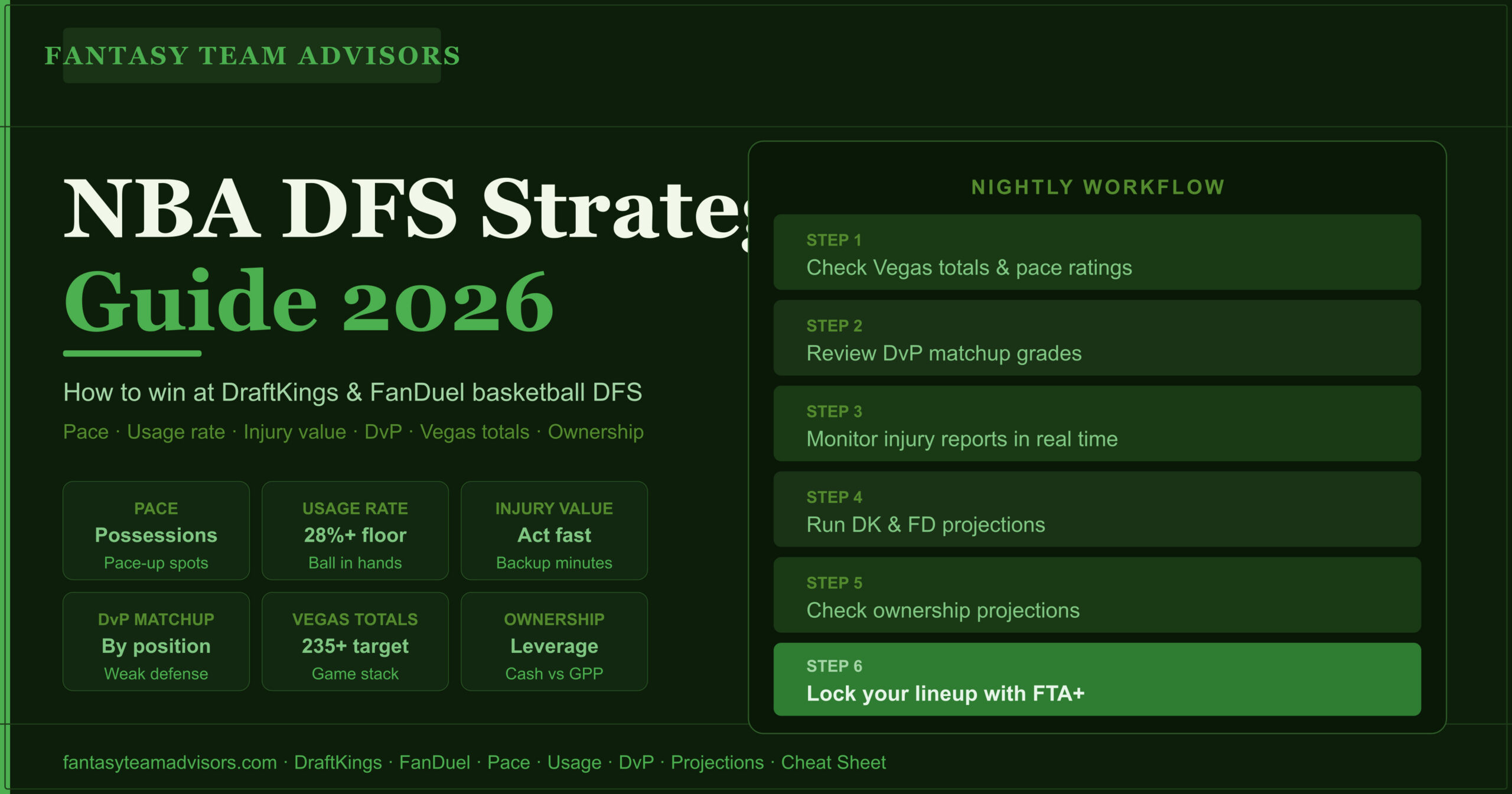
NBA DFS is the fastest-moving daily fantasy sport — slates drop every night, injury news breaks an hour before tip-off, and the player pool shifts dramatically from one game to the next. It rewards players who are quick, informed, and disciplined. At Fantasy Team Advisors, we’ve been building NBA DFS projection models and publishing picks since 2014. This guide covers everything you need to win — from pace and usage rate to injury value, defense vs position matchups, Vegas totals, ownership strategy, and bankroll management for the full NBA season.
NBA DFS basics · Pace of play · Usage rate · Injury value · Defense vs position · Vegas totals · Stacking strategy · Position strategy · Ownership strategy · Contest selection · Bankroll management · DraftKings vs FanDuel · FTA tools · FAQ
NBA DFS basics — how it works
In NBA DFS on DraftKings and FanDuel, you build a lineup of real NBA players within a salary cap. Players earn fantasy points based on their real-game performance that night — points, rebounds, assists, steals, blocks, and turnovers. Whoever builds the highest-scoring lineup in their contest wins.
DraftKings NBA lineup requirements
- 1 point guard (PG)
- 1 shooting guard (SG)
- 1 small forward (SF)
- 1 power forward (PF)
- 1 center (C)
- 1 guard flex (G — PG or SG)
- 1 forward flex (F — SF or PF)
- 1 utility flex (UTIL — any position)
- Salary cap: $50,000
FanDuel NBA lineup requirements
- 2 point guards (PG)
- 2 shooting guards (SG)
- 2 small forwards (SF)
- 2 power forwards (PF)
- 1 center (C)
- Salary cap: $60,000
The key structural differences: DraftKings uses flexible G, F, and UTIL spots that allow you to roster multiple players at the same position, and rewards double-doubles (+1.5 pts) and triple-doubles (+3 pts). FanDuel uses a rigid two-per-position format with no positional flexibility, and does not award double-double or triple-double bonuses. These differences fundamentally change which players are most valuable on each platform — all-around stat-stuffers are more valuable on DraftKings, while pure scorers and defensive specialists gain relative value on FanDuel.
Pace of play — the most important NBA DFS concept
Pace measures how many possessions a team uses per 48 minutes. It’s the single most important contextual factor in NBA DFS because more possessions directly mean more opportunities for every player on the floor — more shots, more rebounds, more assists, more steals, more blocks. A game between two fast-paced teams is a fantasy gold mine compared to a slow, defensive grind.
How pace affects fantasy scoring
Consider two scenarios: in Game A, two teams combine for 200 possessions. In Game B, two teams combine for 180 possessions. All else being equal, players in Game A have 11% more opportunities to accumulate fantasy stats than players in Game B. Over 48 minutes, that difference compounds — the point guard in Game A might get 8 extra shot attempts and 2 extra assist opportunities compared to Game B.
The fastest-paced teams in the NBA typically run around 102-105 possessions per 48 minutes. The slowest teams run around 96-98. A matchup between two fast teams (combined pace 210+) is a significantly better DFS environment than a matchup between two slow teams (combined pace 192).
Pace-up matchups
A “pace-up” matchup occurs when a team that normally plays at a moderate pace faces a significantly faster opponent. The faster team tends to push the pace regardless of the opponent, forcing the slower team to play at a higher tempo than usual. Players on the slower team benefit disproportionately in pace-up matchups — they’re playing more possessions than normal without the salary adjustment that would come from being a known fast-pace player.
Use our NBA DraftKings projections — which incorporate pace data — to identify pace-up matchups on tonight’s slate.
Usage rate — who gets the ball when it matters
Usage rate measures the percentage of a team’s possessions that end with a specific player shooting, drawing a foul, or turning the ball over. A player with a 35% usage rate is involved in 35% of all his team’s possessions when he’s on the court. Usage rate is the most direct measure of a player’s offensive role and is the foundation of fantasy scoring floor projections.
Why usage rate matters for NBA DFS
High-usage players — those above 28% — have the safest floors in NBA DFS because their teams run plays for them regardless of how the game is going. A 30% usage rate player getting 35 minutes will almost always have enough touches to accumulate meaningful stats. Low-usage players (under 18%) are boom-or-bust — they can disappear for stretches and produce very little even with 30+ minutes.
For cash games, target high-usage players in pace-up matchups. The combination of guaranteed touches (usage) and more opportunities (pace) creates the highest-floor plays in basketball DFS.
Usage spikes from injuries
When a high-usage player is ruled out, his usage gets redistributed among his teammates. A team’s second-best player might go from 22% usage to 28% usage when the star sits. This usage spike is one of the most profitable plays in all of DFS — the backup becomes more valuable, usually without a meaningful salary increase because the salary was set before the injury was announced. See the injury value section below for more detail.
Injury value — NBA DFS’s biggest edge opportunity
No sport rewards injury monitoring more than NBA DFS. In the NFL, injuries are usually known days in advance. In MLB, the starting lineup is the primary concern. In the NBA, star players are routinely ruled out on the day of the game — sometimes 30-60 minutes before tip-off — creating massive value opportunities that the general DFS field hasn’t fully priced in yet.
How to capitalize on injury news
When a key player is ruled out, the following players typically see their value increase:
- The backup at the same position — gets direct minutes replacement. If a starting PG is out, his backup goes from 15 minutes to 30+ minutes with elevated usage
- The team’s second-best scorer — usage redistributes to the next highest-usage player. If LeBron is out, whoever handles the ball second-most on the Lakers gets 4-6% more usage
- Spot-start players on a budget — deep bench players who would normally play 10 minutes might play 25 minutes when two players are out. These sub-$4,000 plays can score 30+ DK points and save huge salary for premium plays elsewhere
When to act on injury news
The key is speed. When a star player is ruled out 2 hours before tip-off, his replacement’s value spikes immediately — but if you wait 30 minutes, the replacement’s ownership climbs from 5% to 30% and the GPP leverage disappears. Monitoring injury reports starting at noon ET and checking again 90 minutes before tip-off is essential for NBA DFS success.
Subscribe to FTA+ for real-time injury alerts and projection updates — our models re-run automatically when injury news breaks, flagging value plays before the field catches up.
Defense vs position (DvP) — matchup grading explained
Defense vs Position (DvP) measures how many fantasy points a team allows to each opposing position over the season. A team that ranks 28th in fantasy points allowed to point guards is giving up the most production to opposing PGs in the league — that’s an elite matchup for tonight’s opposing PG.
How to use DvP in NBA DFS
DvP is best used as a confirming signal rather than a standalone reason to roster a player. A high-usage player in a pace-up game who also faces a weak DvP matchup is a three-layer conviction play — usage (floor), pace (ceiling), and matchup (opportunity) all pointing in the same direction. That’s your cash game anchor.
Key DvP tiers to know:
- Top 5 DvP (best matchups): Teams allowing the most fantasy points to a position over the season. Target opposing players at this position aggressively in both cash and GPP
- Bottom 5 DvP (worst matchups): Teams allowing the fewest fantasy points to a position. Fade players in these matchups unless they have a massive usage or pace edge that overrides the poor matchup
- Middle of the pack DvP: Matchup is neutral — usage rate, pace, and salary value matter more than DvP in the middle tier
Use our NBA projection models which incorporate DvP data into every player’s projected fantasy total.
When DvP misleads
DvP can mislead when a team has recently changed its defensive personnel through trades or injuries. A team that was historically bad defending point guards but just traded for an elite PG defender will show outdated DvP numbers that don’t reflect their current defense. Always check recent box scores (last 2 weeks) alongside season-long DvP to catch these shifts.
Vegas totals — reading the market for NBA DFS
Vegas game totals are the sharpest available signal for how much scoring the market expects in an NBA game. High-total games (235+) mean both teams are projected to score significantly, creating a target-rich environment for offensive players. Low-total games (210 and under) signal a projected defensive battle where fewer fantasy points will be distributed.
Using implied team totals
Just like MLB, you can derive implied team totals for NBA games from the spread and over/under. A game with a total of 230 and a spread of -6 implies roughly:
- Favorite: ~118 points
- Underdog: ~112 points
Teams with implied totals of 115+ are your primary stack and cash game targets. Players on teams with implied totals under 105 carry more risk regardless of individual usage or matchup data.
Total movement as a signal
A game total moving up from 224 to 230 during the week signals that sharp money expects more scoring — often because of an injury to a key defender, a confirmed fast-pace matchup, or favorable officiating crew. Total movement of 3+ points in NBA is significant and worth increasing your exposure to that game’s offensive players.
Check our NBA Vegas odds page for current game totals and implied team totals.
Stacking strategy in NBA DFS
NBA stacking works differently from NFL and MLB. In football and baseball, correlation is tightly structured — a QB’s receivers directly benefit from his production. In basketball, correlation is softer because all five players on the floor share possessions and can contribute to the same scoring plays.
Game stacking
The primary stacking strategy in NBA DFS is game stacking — rostering multiple players from the same high-total game. In a game projected to score 235+ total points, every player on the floor has more opportunity. A point guard and power forward from Team A combined with a shooting guard from Team B all benefit from the same fast-paced, high-scoring game environment.
Game stacks work best when:
- The game total is 230+ (both teams expected to score freely)
- The spread is under 7 points (close game = both teams playing offense all night)
- Both teams have fast pace ratings
- Neither team has a dominant defensive stopper that could anchor a low-scoring half
Team stacking
Team stacking — rostering multiple players from the same team — is riskier in NBA than game stacking because players on the same team compete for the same possessions. Two players from the same team can both score well, but their production is less correlated than two players from the same game. The exception is teams with two elite usage players (think a team with a star PG and star SF both at 28%+ usage) — those players’ production is somewhat independent because they run different plays.
Avoid over-stacking
Unlike MLB where 4-5 man stacks are standard, NBA lineups with 4+ players from the same team are dangerous. On a team with 100 possessions, 4 players rostered means you’re heavily concentrated in one team’s production. If that team underperforms, your entire lineup tanks. Keep NBA stacks to 2-3 players from a single game or team maximum.
Position-by-position NBA DFS strategy
Point guard
Point guards are the most consistent position in NBA DFS because they control the ball and accumulate assists regardless of whether they’re scoring. Elite PGs with 30%+ usage rates and 8+ assist opportunities per game have the highest floors in basketball DFS. In cash games, pay up for a primary ball-handler in a pace-up matchup. In GPPs, pivot PGs — secondary ball-handlers who take over when the starter rests — offer tournament-winning upside at lower salaries.
Shooting guard
Shooting guards are the most volatile position in NBA DFS. The range between an elite SG starter (30+ DK points) and a filler (under 15 DK points) is enormous. Focus on SGs who handle the ball — combo guards who can create their own shot and accumulate assists alongside points are significantly safer than off-ball shooters who depend on being open and hot from three.
Small forward
Small forwards with dual position eligibility (SF/PF on DraftKings) are highly valuable for roster construction flexibility. Target SFs who contribute across multiple stat categories — points, rebounds, and assists — rather than one-dimensional scorers. Multi-category contributors have higher floors because they accumulate stats in multiple ways.
Power forward
Power forwards who face weak interior defenders are prime DFS targets. Look for PFs in pace-up matchups against teams that rank in the bottom 10 for DvP at the power forward position. Big men who run the floor in transition — getting easy baskets off fast breaks — benefit disproportionately in pace-up games.
Center
Centers are the most polarized position in NBA DFS. Elite starting centers (Nikola Jokic-type players) score the most fantasy points per game of any position due to their combination of points, rebounds, assists, and blocks. But the drop-off to the second tier is steep. Centers who face foul-prone opposing big men can add free throw attempts — a consistent fantasy point source — to their projection.
On DraftKings, centers who contribute double-doubles (10+ rebounds or 10+ points + rebounds) add a +1.5 bonus that can be the difference between a good and great fantasy game. Target centers averaging 10+ rebounds against teams that give up the most rebounds to opposing centers.
Ownership strategy in NBA DFS
Ownership in NBA DFS is more volatile than in NFL because injury news breaks so close to game time. A player projected at 8% ownership can jump to 35% if his teammate is ruled out 90 minutes before tip-off. This volatility creates both risks and opportunities.
Cash game ownership
In cash games, roster the chalk. NBA cash games reward consistency — the players the field is heavily rostering are usually in the clearest positive spots. A star player at 40% ownership in a pace-up matchup facing a weak DvP is 40% owned for a reason. Match the field in cash games and compete on the margins with your flex spot.
GPP ownership in NBA
NBA GPP ownership strategy centers on two scenarios:
- Late injury pivots: When a star is ruled out 90 minutes before tip-off, the backup becomes obvious value — but his ownership explodes. In large-field GPPs, a backup playing 35 minutes at 45% ownership is not a leverage play. The real leverage is finding the second-order value — the player who benefits from the backup getting more minutes, or a player on the opposing team who now faces a weaker defense
- Contrarian stars in good spots: The highest-leverage GPP play in NBA is a star player at low ownership due to a perceived “bad matchup” who actually has a great matchup on closer analysis. A star PG at 12% owned because he faces an “elite defender” who actually has a poor DvP this season is a massive GPP leverage play if he goes off
Contest selection in NBA DFS
Slate types
- Main slate (6+ games): The deepest player pool and largest prize pools. Most competitive but best for multi-entry GPP strategies. The 8-12 game main slates on Tuesdays and Thursdays offer the best value hunting
- Smaller slates (3-5 games): Fewer games mean less player pool depth but also less variance. Injury news has an amplified impact on small slates — one star ruled out can shift 20% of the slate’s value
- 2-game slates: Extreme variance. Essentially a showdown slate with slightly more roster flexibility. Only enter GPPs — cash games on 2-game slates are too dependent on a single player having a big game
- Single-game showdowns: Same as NFL — pick a captain/MVP multiplier and build a correlated lineup around both teams in a high-total game
Timing your lineup locks
NBA DFS has a unique timing challenge: games tip off at different times, with early games (7pm ET) locking before late games (10:30pm ET). Main slate lock usually occurs at the first tip-off time. Always check injury reports 30-60 minutes before the first game locks and be prepared to make late swaps if your platform allows them.
Bankroll management in NBA DFS
NBA is the most consistent sport for bankroll building in DFS because there are games almost every night from October through June. The sheer volume of slates means even small edges compound significantly over a full season — but it also means you can lose money very quickly if you’re not disciplined.
Per-slate exposure limits
Never risk more than 15-20% of your total DFS bankroll on any single NBA slate. The NBA’s injury volatility means any given slate can be derailed by a star ruling out at tip-off. Keeping individual slate exposure under 20% ensures you can survive a catastrophic slate without damaging your ability to play the rest of the season.
Volume strategy
The biggest edge in NBA DFS comes from playing consistently across the full season rather than going big on individual nights. A player with a 55% cash game win rate playing 150 slates per season is far more profitable than one who bets big on 20 slates and breaks even. NBA DFS rewards volume and consistency above all else.
Early season vs late season strategy
Early in the NBA season (October-November), rotations are still being established and minutes projections are unreliable. Reduce your cash game exposure in early October until each team’s rotation becomes clearer. By December, rotations are stable and cash game projections become significantly more reliable — this is when you should increase your cash game volume.
DraftKings vs FanDuel NBA — key differences
| Stat | DraftKings | FanDuel |
|---|---|---|
| Point | 1 pt | 1 pt |
| 3-pointer made | +0.5 pts | None |
| Rebound | 1.25 pts | 1.2 pts |
| Assist | 1.5 pts | 1.5 pts |
| Steal | 2 pts | 2 pts |
| Block | 2 pts | 2 pts |
| Turnover | -0.5 pts | -1 pt |
| Double-double bonus | +1.5 pts | None |
| Triple-double bonus | +3 pts | None |
The most important differences: DraftKings rewards 3-point shooting (+0.5 per make), which makes high-volume three-point shooters more valuable on DK. DraftKings also awards double-double and triple-double bonuses — so all-around stat-stuffers like point guards who average 10+ assists and big men who average 10+ rebounds get a significant bonus that doesn’t exist on FanDuel. FanDuel penalizes turnovers more harshly (-1 vs -0.5), making turnover-prone ball-handlers slightly less valuable on FD.
The practical implication: players like high-volume all-around centers and triple-double threat point guards are better on DraftKings. Pure scorers, defensive specialists (blocks and steals), and efficient low-turnover players are relatively better on FanDuel.
FTA tools for NBA DFS — your nightly workflow
Here’s the optimal pre-slate workflow using FTA’s NBA DFS tools:
- Check Vegas totals — use our NBA Vegas odds page to identify the highest-total games and implied team totals for the night
- Review DraftKings projections — our NBA DK projections incorporate pace data, DvP matchups, and usage rates to rank every player on the slate by projected fantasy points
- Review FanDuel projections — our NBA FD projections apply FanDuel scoring (no double-double bonus, stricter turnover penalty) for platform-specific rankings
- Check injury reports — NBA injury news moves fast. Check reports 2 hours before tip-off and again 30-60 minutes before lock. When stars are ruled out, re-run projections immediately to catch value plays before the field adjusts
- Identify pace-up matchups — use our projection tools to flag which games have the highest combined pace ratings for tonight’s slate
- Check ownership projections — identify chalk plays for cash games and low-owned leverage plays for GPPs
- Review the cheat sheet — our NBA DFS cheat sheet consolidates tonight’s top plays into a quick-reference guide for your final lineup build
- Read tonight’s picks post — our NBA DFS picks synthesize everything above into specific player recommendations for DraftKings and FanDuel
Get the full FTA edge with FTA+FTA+ gives you real-time injury alerts and automatic projection updates, premium NBA sim models, daily cheat sheets, and early access to picks for every sport — everything you need to execute this strategy profitably every night of the NBA season.
NBA DFS strategy FAQ
What is the most important factor in NBA DFS?
Pace of play is the most important contextual factor — more possessions mean more fantasy scoring opportunities for every player on the floor. Combined with usage rate (who gets the ball) and matchup quality (DvP), pace forms the three-pillar foundation of NBA DFS analysis. The best cash game plays combine high usage, a pace-up matchup, and a weak DvP — all three pointing in the same direction.
How do injuries affect NBA DFS strategy?
Injuries are the biggest single-game value creator in NBA DFS. When a star player is ruled out on game day, his backup gets significantly more minutes and usage — often at a salary that hasn’t been adjusted to reflect the new role. The key is speed: acting on injury news within minutes of the announcement, before the field adjusts ownership and before the value is fully priced in.
What is Defense vs Position (DvP) in NBA DFS?
DvP measures how many fantasy points a team allows to each opposing position per game over the season. A team ranked 28th in DvP for point guards is giving up the most production to opposing PGs in the league — that’s a premier matchup. Use DvP as a confirming signal alongside usage rate and pace data, not as a standalone reason to roster a player.
Should I play cash games or GPPs in NBA DFS?
Both have value in a sustainable NBA DFS strategy. Cash games (50/50s, H2H) reward consistent high-floor plays and benefit from the slate’s best-defined matchups. GPPs reward injury pivots, contrarian plays, and high-ceiling game stacks. A 60/40 cash/GPP split is a solid starting point, with the option to shift more toward GPPs on slates where you have high conviction on a specific injury value play.
Is DraftKings or FanDuel better for NBA DFS?
Both platforms are excellent. DraftKings rewards all-around stat-stuffers and three-point shooters with bonus scoring and double-double/triple-double bonuses. FanDuel rewards pure scorers and defensive specialists and penalizes turnovers more harshly. The optimal lineup differs meaningfully between the two, which is why FTA builds separate projection models for each platform. Playing both gives you genuine diversification each night.
How many players should I stack in NBA DFS?
The optimal NBA DFS stack is 2-3 players from the same high-total game. Unlike MLB where 4-5 man team stacks are standard, NBA team stacks larger than 3 become counterproductive because players on the same team share possessions. Game stacks (2 from one team, 1 from the opposing team) in high-total matchups are the most reliable stacking approach in basketball DFS.
What time should I build NBA DFS lineups?
Build initial lineups once DraftKings and FanDuel post the nightly slate (usually by mid-morning). Monitor injury reports throughout the afternoon. Check 90 minutes before tip-off for the latest questionable and out designations. Finalize lineups 30-45 minutes before the first game locks — this captures most late scratches while giving you time to adjust before lock.
How do I find value plays in NBA DFS?
The four best sources of NBA DFS value are: injury replacements (backups stepping into larger roles), pace-up matchups at mid-tier salaries (good players in unexpectedly fast games), players in their first game back from injury (low salary reflecting an absence, but full role returning), and spot-starters on teams with multiple absences. Our NBA projection models flag value plays — players projecting significantly above their salary tier — automatically on every slate.
Where to play MLB DFS
Once you’ve got your lineup built using the strategy above, you need
somewhere to play it. FTA covers MLB DFS on both DraftKings and FanDuel —
and for most players, playing on both platforms gives you the best edge
since ownership differs significantly between the two sites.
DraftKings is the better platform for MLB GPP tournaments thanks to its
larger prize pools and two-pitcher roster construction. FanDuel is often
better for cash games due to its half-PPR scoring and single-pitcher format
which rewards consistent contact hitters. If you’re new to DFS or deciding
which site to focus on, read our full breakdown of the
best DFS sites
in 2026 — we compare DraftKings, FanDuel, PrizePicks, and Underdog
Fantasy across pricing, contests, and which sports each platform does best.
Last updated: June 2026. Strategy principles are evergreen but specific tools, scoring, and salary caps may change — always verify current platform rules before playing.