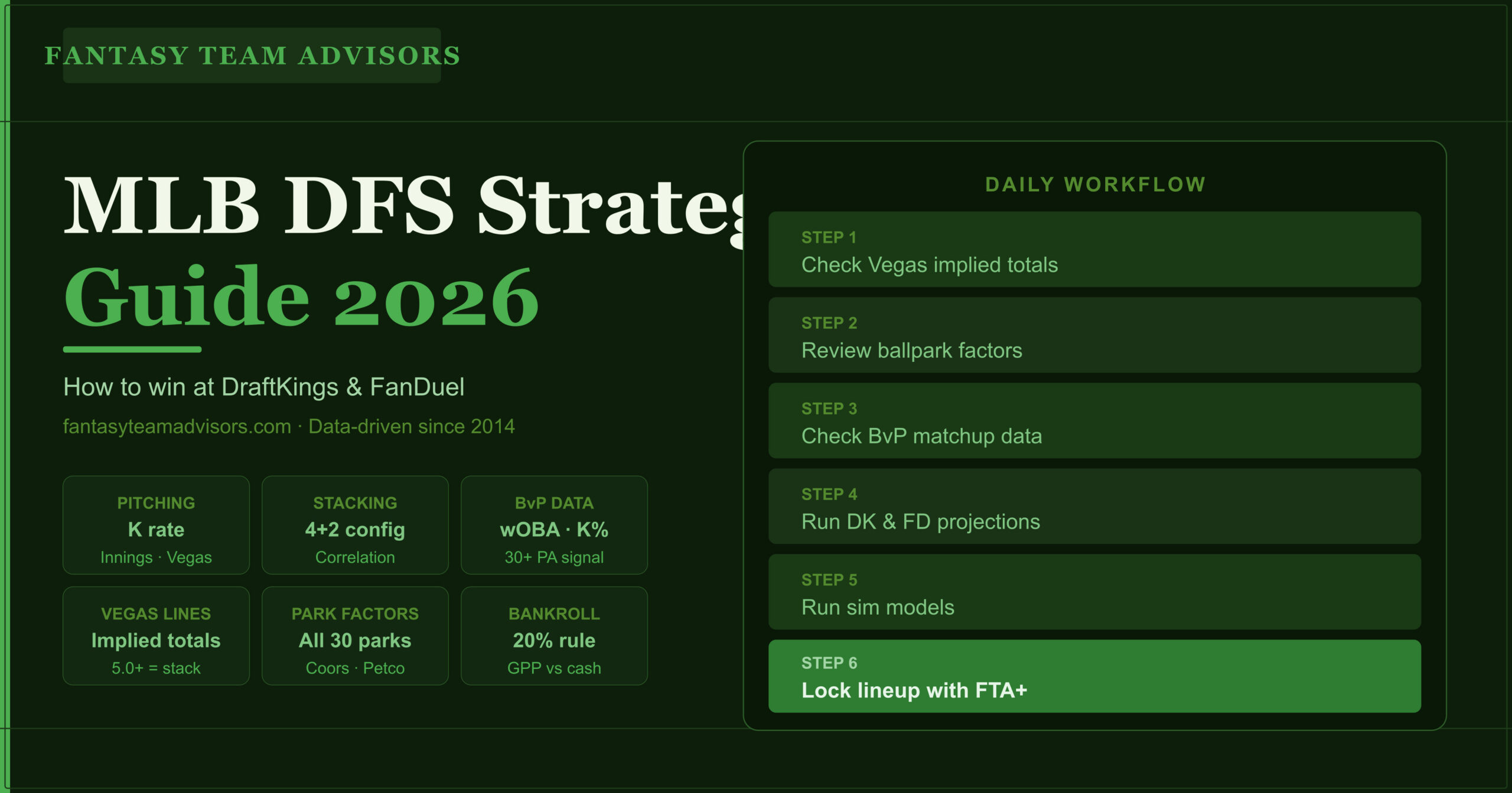
MLB DFS Strategy Guide 2026 – How to Win at Baseball Daily Fantasy on DraftKings & FanDuel
MLB is the most played sport in daily fantasy sports for one simple reason: there’s a slate every single day from late March through October. That’s 180+ days of opportunity. But it’s also one of the most complex sports to master. At Fantasy Team Advisors, we’ve been building projection models and publishing MLB DFS picks since 2014. This guide covers everything you need to win — from lineup construction and stacking theory to pitcher selection, BvP data, Vegas lines, park factors, weather, and bankroll management.
Basics of MLB DFS · Pitcher selection · Stacking strategy · BvP matchups · Vegas lines & implied totals · Park factors · Weather · Contest selection · Bankroll management · DraftKings vs FanDuel · FTA tools · FAQ
MLB DFS basics — how it works
In MLB DFS on DraftKings and FanDuel, you build a lineup of real baseball players within a salary cap. Players earn fantasy points based on their real-game performance. Whoever builds the highest-scoring lineup wins.
DraftKings MLB lineup requirements
- 2 pitchers (SP + SP or SP + RP)
- 1 catcher (C)
- 1 first baseman (1B)
- 1 second baseman (2B)
- 1 third baseman (3B)
- 1 shortstop (SS)
- 3 outfielders (OF)
- 1 flex spot (any hitter)
- Salary cap: $50,000
FanDuel MLB lineup requirements
- 1 pitcher (SP)
- 1 catcher/first baseman (C/1B)
- 1 second baseman (2B)
- 1 shortstop (SS)
- 1 third baseman (3B)
- 4 outfielders (OF)
- 1 utility (any hitter)
- Salary cap: $35,000
The biggest difference: DraftKings uses two pitchers, FanDuel uses one. This fundamentally changes how you allocate salary. On DraftKings, you’re often spending $16,000–$20,000 just on pitching. On FanDuel, one pitcher frees up more salary for premium hitters.
Pitcher selection — the foundation of every winning lineup
Pitching is the single most important decision you’ll make in MLB DFS. A dominant pitching performance is the highest-ceiling play in baseball — a starter who throws 7 innings, gives up 1 run, and strikes out 10 batters can score 50+ DraftKings points on his own. Getting pitching right sets the foundation for everything else.
The five pillars of elite pitcher selection
1. Strikeout rate (K/9 and K%)
Strikeouts are the safest, most reliable source of fantasy points for pitchers. A strikeout is a single event that directly scores points regardless of what happens around it — it doesn’t depend on fielders, luck, or sequencing. Elite strikeout pitchers have a K% above 28% and a K/9 above 10.0. These are your SP1-tier targets.
Always cross-reference the pitcher’s strikeout rate with the opposing team’s strikeout rate. A 30% K rate pitcher facing a team that strikes out 27% of the time is dramatically better than the same pitcher facing a team that makes contact 80% of the time. Use our BvP matchup tool to find these edges quickly.
2. Implied runs allowed (Vegas lines)
Vegas sets implied team totals for every game — these are the market’s best estimate of how many runs each team will score. A pitcher facing a team with a low implied total (4.0 or under) is in a favorable spot. A pitcher facing a team with a high implied total (5.5+) is in a dangerous spot regardless of his personal stats.
Check our MLB Vegas odds tool for current implied totals before finalizing any pitcher.
3. Innings pitched projection
Pitchers only earn points while they’re in the game. A starter projected for 5 innings with a high K rate is often less valuable than a starter projected for 7 innings with a slightly lower K rate. Look for starting pitchers with: a recent average of 6+ innings per start, no pitch count restrictions, and no injury history that suggests early hooks.
4. BvP history against today’s opponent
Batter vs pitcher historical data is a core part of FTA’s analysis. While small sample sizes can be misleading, patterns of 30+ plate appearances carry real signal. A pitcher who has consistently dominated a lineup — high K rate, low wOBA allowed — is a stronger pick than his season stats alone suggest. See our full BvP matchup database for today’s slate.
5. Park factors and home/away splits
Some ballparks dramatically suppress offense — pitcher-friendly parks like Petco Park (San Diego), Oracle Park (San Francisco), and Kauffman Stadium (Kansas City) consistently lower scoring. Pitching in these parks adds a meaningful safety floor to your pitcher. Conversely, avoid starting pitchers in extreme hitter’s parks like Great American Ball Park (Cincinnati) and Coors Field (Colorado) unless the matchup and salary are irresistible.
Use our MLB ballpark factors tool to check park ratings before every slate.
Pitcher tiers for DFS
- SP1 (elite): 30%+ K rate, 6+ projected innings, facing a team with an implied total under 4.0, in a neutral or pitcher-friendly park. Pay up for these — they’re the backbone of winning lineups.
- SP2 (strong): 24-29% K rate, 5-6 projected innings, facing a below-average offense. Great for DraftKings’ second pitcher slot or FanDuel main slates.
- Value SP (pivot): Salary under $7,000 DK / $8,000 FD with a favorable matchup. Use these to free up salary for a dominant hitting stack when no SP1 is available.
Stacking — the key to GPP tournament wins
Stacking is the most important offensive strategy in MLB DFS. A stack means rostering multiple hitters from the same team in the same lineup. The reason stacking works is correlation — when one hitter in a batting order gets on base, the hitters around him are more likely to drive in runs, score runs, and have productive at-bats. That correlation dramatically increases your ceiling in tournament play.
How many hitters to stack
The industry standard for GPP (tournament) lineups is a primary stack of 4-5 hitters from one team, plus a secondary mini-stack of 2-3 hitters from a different team. This 4+2 or 5+2 configuration is how most winning GPP lineups are structured. Never build a tournament lineup with one-off hitters from 8 different teams — the lack of correlation kills your upside.
For cash games (50/50s and head-to-head), a 3-man stack from one top team is often sufficient. Cash games reward floor, not ceiling, so you don’t need the aggressive 5-man stacks that GPPs require.
How to identify the best stack
The best stacks come from teams that combine all of these factors:
- High implied run total — Vegas is pricing in a high-scoring game for this team
- Weak opposing pitcher — high ERA, high wOBA allowed, low K rate (the hitters will make contact)
- Favorable park — hitting in a hitter-friendly ballpark boosts run-scoring upside
- Good weather — wind blowing out, warm temperatures, low humidity all boost offense
- Favorable BvP history — the team’s hitters have performed well against today’s opposing pitcher historically
Use our DraftKings MLB projection models to quickly rank today’s best stacks by projected team runs scored.
Which hitters to include in your stack
The best stacks include consecutive or near-consecutive batters in the lineup. Hitters batting 1-2-3 in the order have the highest correlation — they come up to bat in the same innings, are on base for each other, and score together. Spacing hitters too far apart (1, 4, 7) reduces the correlation benefit significantly.
Within a stack, identify:
- The anchor — your highest-salary, highest-projection hitter in the stack (often batting 3rd or 4th in the order)
- The premium play — a second hitter at $4,500+ who bats adjacent to the anchor
- The value play — a lower-salary hitter ($3,000-$3,800 on DK) who bats 5th or 6th and gives you roster construction flexibility
Mini-stacks (secondary stacks)
After your primary stack, add 2-3 hitters from a second team in a favorable game. Your mini-stack should come from a game with a high total (9.5+) where the opposing pitcher is also weak. The mini-stack diversifies your lineup so that if your primary stack underperforms, you have correlation working from a second direction.
BvP matchups — batter vs pitcher data explained
BvP (batter vs pitcher) data shows how individual hitters have performed against a specific pitcher historically. It’s one of FTA’s most powerful tools and a key differentiator in our daily analysis.
How to use BvP data correctly
BvP data is most reliable when you have 30+ plate appearances between a hitter and pitcher. Smaller samples can mislead — a hitter going 5-for-8 against a pitcher is a hot streak, not a meaningful edge. But a hitter with 45 PA against a pitcher, batting .340 with a .420 wOBA and elevated hard-hit rate? That’s a real signal.
Key BvP stats to look for:
- wOBA — weighted on-base average, the single best measure of overall offensive production. A wOBA above .380 against a specific pitcher is excellent.
- K% — strikeout rate in that matchup. A hitter who rarely strikes out against a pitcher is more consistent than one who hits home runs but also whiffs frequently.
- Hard-hit rate — measures how often a batter makes hard contact. Sustained hard-hit rates against a pitcher suggest the hitter has seen this pitcher enough to time his stuff.
- HR/FB rate — home run per fly ball rate. A hitter who consistently elevates the ball against a specific pitcher in a hitter-friendly park is a prime power stack target.
Access today’s complete BvP data on our MLB BvP matchup tool — updated daily for the current slate.
When to fade BvP data
BvP data can create traps. If a hitter has great BvP numbers against tonight’s starter but is batting 7th in the lineup, facing a park that suppresses his home run type, against a team with a low implied total — fade the BvP. Context always wins over a single data point. Use BvP as a confirming signal, not a standalone reason to roster a player.
Vegas lines and implied totals — the sharpest data in DFS
Vegas sportsbooks employ hundreds of analysts and set lines that reflect the sharpest available information about each game. Implied team totals — derived from the over/under and moneyline — tell you how many runs Vegas expects each team to score. This is the most important single data point for identifying stack targets.
How to calculate implied team totals
If a game has an over/under of 9.0 and the home team is a -140 favorite, the implied totals are roughly:
- Home team implied total: ~4.9 runs
- Away team implied total: ~4.1 runs
The favorite always gets slightly more of the total. Teams with implied totals of 5.0 or higher are your primary stack targets. Teams with implied totals under 3.5 are fade candidates for hitting and target candidates for pitching.
Check current implied totals on our MLB Vegas odds page — updated in real time as lines move.
Line movement as a signal
Pay attention to how totals move from open to close. If a game opened at 8.5 and has moved up to 9.5 by game time, sharp money is indicating a higher-scoring game than originally expected. Conversely, a total moving down suggests pitching news (a better starter than expected, or a confirmed ace) that the market is pricing in. Line movement is one of the most underused signals in DFS.
Park factors — not all ballparks are equal
Baseball is unique among major sports in that the playing field varies enormously between venues. Coors Field in Colorado sits at over 5,000 feet elevation — the thin air dramatically reduces ball carry resistance, inflating offense by 20-30% compared to an average park. Petco Park in San Diego suppresses offense significantly. These differences are massive for DFS.
Hitter-friendly parks (target for stacking)
- Coors Field (COL) — extreme hitter’s park, highest offense in baseball
- Great American Ball Park (CIN) — strong hitter’s park, elevated HR rates
- Citizens Bank Park (PHI) — above-average offense, good for power hitters
- Yankee Stadium (NYY) — short right field porch, elevated HR rates for lefties
- Wrigley Field (CHC) — wind-dependent, but when wind blows out becomes elite for offense
Pitcher-friendly parks (target for pitching)
- Petco Park (SD) — strong pitcher’s park, suppresses HR and scoring
- Oracle Park (SF) — strong pitcher’s park, especially for righties
- Kauffman Stadium (KC) — spacious outfield, below-average offense
- Tropicana Field (TB) — dome, consistent but pitcher-friendly dimensions
- Oakland Coliseum (OAK) — one of the largest foul territories in baseball, pitcher-friendly
Use our MLB ballpark factors tool for complete park ratings across all 30 stadiums.
Weather — the most overlooked DFS edge
Outdoor baseball games are directly affected by weather in ways that significantly impact scoring. Most DFS players don’t check weather before locking lineups — this is one of the easiest edges to exploit.
Wind direction and speed
Wind blowing out to center or to left/right field at 15+ mph can add 10-15% to the game total for power hitters. Wind blowing in from center suppresses home runs significantly. Always check wind direction and speed for outdoor games, especially at Wrigley Field where wind direction is the single biggest variable in the park’s DFS value on any given day.
Temperature
Warmer temperatures increase ball carry — a ball hit at the same exit velocity travels further in 85°F weather than in 50°F weather. Afternoon games in hot climates (Texas, Arizona, Atlanta in summer) can add meaningful power upside. Cold night games in April/early May in northern cities (Chicago, Minneapolis, Cleveland) suppress offense.
Rain and postponement risk
Always check weather for rain risk before locking lineups, especially in cash games. A game postponed or called after 4.5 innings can ruin your lineup. If there’s 40%+ rain probability for an outdoor game, reduce your exposure to that game’s players — especially pitchers who need 5 innings to qualify for a win.
Contest selection — GPP vs cash games
Choosing the right contest type is as important as building the right lineup. The strategies for GPP tournaments and cash games are fundamentally different.
Cash games (50/50s, head-to-head, double-ups)
In cash games, roughly the top 50% of entries win. You’re not trying to hit a home run — you’re trying to avoid a strikeout. Cash game strategy prioritizes:
- Consistency over ceiling — target players with high floors, not boom-or-bust plays
- Elite pitching — a dominant starter is the safest cash game anchor
- 3-man stacks from top implied total teams — enough correlation for upside, not so aggressive it kills your floor
- Avoid injury risk and weather risk — one postponed player can cost you a cash game
- Confirmed lineups only — never roster a player who hasn’t been confirmed in the starting lineup
GPP tournaments (large field, high prize)
In GPPs, only the top 15-20% of entries win, and the prize pool is heavily weighted to the top finishers. You need a high-ceiling lineup, not just a safe one. GPP strategy prioritizes:
- Aggressive stacking — 4-5 man primary stack plus a mini-stack
- Contrarian plays — fading the chalky (most popular) plays to gain leverage if they underperform
- Correlation everywhere — your pitcher should ideally NOT be from the same game as your stack (you don’t want to root against your own hitters)
- Salary efficiency — find value plays that free up salary for premium stacks
- Multiple lineups — enter 3-10 lineups in large GPPs with different stack combinations
Single-game showdown contests
DraftKings and FanDuel both offer single-game contests where you build a lineup from just one game. These have massive volatility — a single big inning can win you the contest. Stack 4-5 hitters from the team you project to win, add the opposing team’s ace pitcher, and look for a “captain” or “MVP” flex multiplier pick with the highest ceiling in the game.
Bankroll management — how to play for the long run
The best lineup in the world won’t help you if you blow your bankroll on one bad slate. Professional DFS players treat their bankroll like a business investment and apply strict rules to how much they risk per slate.
The 20% rule
Never risk more than 20% of your total bankroll on any single slate. If you have $500 in your DFS accounts, your maximum exposure for Monday’s MLB slate is $100. This ensures that even a catastrophic slate — rain delays, injuries, blown games — can’t wipe you out.
Cash game vs GPP allocation
For most players, a 60/40 split between cash games and GPPs is appropriate: 60% of your per-slate budget goes into 50/50s and H2H contests, 40% goes into GPP tournaments. Cash games provide a consistent, sustainable return. GPPs provide the lottery-ticket upside that makes DFS exciting. As you become more experienced, you can shift more toward GPPs.
Multi-entry strategy
In large-field GPPs, entering multiple lineups with different stack combinations gives you better coverage of the variance space. If you’re entering a $5 GPP, consider entering 5 different $1 lineups instead of one $5 lineup — the exposure is the same but you’re not putting all your eggs in one basket.
Track your results
Keep a simple spreadsheet tracking every contest entered, buy-in, and cash out. Most DFS players dramatically overestimate their win rate until they see the numbers. Honest tracking tells you which sports, contest types, and slate sizes are actually profitable for you — and which ones to cut.
DraftKings vs FanDuel MLB — key differences
FTA builds separate projection models for DraftKings and FanDuel because the optimal lineup on each platform is genuinely different. Here’s what you need to know.
Scoring differences
| Stat | DraftKings | FanDuel |
|---|---|---|
| Single | 3 pts | 3 pts |
| Double | 5 pts | 6 pts |
| Triple | 8 pts | 9 pts |
| Home run | 10 pts | 12 pts |
| RBI | 2 pts | 3.5 pts |
| Run scored | 2 pts | 3.2 pts |
| Walk | 2 pts | 2.6 pts |
| Stolen base | 5 pts | 6 pts |
| Pitcher strikeout | 2 pts | 3 pts |
| Pitcher win | 4 pts | 6 pts |
| Earned run allowed | -2 pts | -3 pts |
FanDuel scores extra-base hits and run-creating events (runs, RBIs) significantly higher than DraftKings. This means power hitters with high run production are more valuable on FanDuel. On DraftKings, the second pitcher slot means pitching is even more important — you need two viable starters, which is why the DK pitcher market is more competitive.
Lineup construction differences
Because FanDuel only uses one pitcher, you have significantly more salary to allocate to hitters. This allows you to stack a premium 4-man group from a top offense without sacrificing pitcher quality. On DraftKings, two pitchers consuming $16,000-$20,000 of your $50,000 cap means roster construction requires more creative value hunting.
FTA tools for MLB DFS — your daily workflow
Here’s the optimal pre-slate workflow using FTA’s full suite of MLB DFS tools:
- Check Vegas odds and implied totals — use our MLB odds page to identify the highest implied total games and best stack targets
- Check ballpark factors — use our ballpark factors tool to confirm park context for your top stacks and pitchers
- Review pitcher BvP data — use our BvP matchup tool to grade each starting pitcher against today’s opponent
- Run DraftKings projections — our DK MLB projections rank every player by projected fantasy points, updated daily once lineups are confirmed
- Run FanDuel projections — our FD MLB projections use FanDuel scoring to rank the same slate differently
- Run sim models — our DraftKings sim models run thousands of lineup simulations to find the optimal stack combinations
- Review the cheat sheet — our MLB DFS cheat sheet consolidates the top plays into a quick reference for building your final lineups
- Read today’s picks post — our MLB DFS picks today article synthesizes everything above into specific player recommendations
Get the full FTA edge with FTA+FTA+ gives you early access to picks before lineup lock, premium simulation models, deeper projection data, and exclusive cheat sheets for MLB, NFL, NBA, PGA, NASCAR and MMA. Everything you need to execute this strategy profitably every day.
MLB DFS strategy FAQ
What is the most important factor in MLB DFS?
Pitching is the single most important factor. A dominant starting pitcher can score 40-60 DraftKings fantasy points on his own — more than most hitters. Getting pitching right sets the floor and ceiling for your entire lineup. After pitching, identifying the right team to stack against a weak pitcher in a hitter-friendly park is the second most important skill.
How many hitters should I stack in MLB DFS?
For GPP tournaments, a primary stack of 4-5 hitters plus a mini-stack of 2-3 hitters from a second team is the standard winning configuration. For cash games, a 3-man stack from the top implied total team is sufficient. Never build a tournament lineup with one-off hitters from 8 different teams — correlation is the key to GPP upside.
Should I use BvP data in MLB DFS?
Yes, but with context. BvP data is most reliable with 30+ plate appearances. Use it as a confirming signal — a hitter with great season stats AND great BvP numbers against tonight’s pitcher is a stronger play than either signal alone. Avoid using small-sample BvP data (under 15 PA) as a standalone reason to roster a player.
What is an implied team total in MLB DFS?
An implied team total is Vegas’s estimate of how many runs that team will score, derived from the over/under and moneyline. Teams with implied totals of 5.0 or higher are your primary stack targets. Teams with implied totals under 3.5 are strong pitcher targets. You can find today’s implied totals on our MLB Vegas odds page.
Is DraftKings or FanDuel better for MLB DFS?
Both platforms are excellent and we recommend playing both. DraftKings uses two pitchers and has larger prize pools. FanDuel uses one pitcher and scores extra-base hits and run production higher. The optimal lineup differs meaningfully between the two platforms, which is why FTA builds separate projection models for each. Playing both gives you genuine diversification.
How do park factors affect MLB DFS?
Park factors measure how much a stadium inflates or suppresses offense relative to an average park. Coors Field in Colorado is the most extreme — it inflates offense by roughly 25-30%. Petco Park in San Diego suppresses offense significantly. Always factor in park when evaluating stack targets and pitchers. Use our ballpark factors tool for current park ratings.
How should I manage my bankroll in MLB DFS?
Never risk more than 20% of your total bankroll on a single slate. Allocate roughly 60% of your per-slate budget to cash games (50/50s and H2H) and 40% to GPP tournaments. Track every contest entered and cashed to honestly evaluate your win rate by sport and contest type.
What time should I build my MLB DFS lineups?
Build initial lineups once DraftKings and FanDuel post salaries (usually by 8-10am ET for main slates). Confirm and finalize lineups 1-2 hours before the first game locks — this is when most starting lineups are confirmed, late scratches are announced, and final weather data is available. FTA+ subscribers get early access to picks and projections before the general release.
Where to play MLB DFS
Once you’ve got your lineup built using the strategy above, you need
somewhere to play it. FTA covers MLB DFS on both DraftKings and FanDuel —
and for most players, playing on both platforms gives you the best edge
since ownership differs significantly between the two sites.
DraftKings is the better platform for MLB GPP tournaments thanks to its
larger prize pools and two-pitcher roster construction. FanDuel is often
better for cash games due to its half-PPR scoring and single-pitcher format
which rewards consistent contact hitters. If you’re new to DFS or deciding
which site to focus on, read our full breakdown of the
best DFS sites
in 2026 — we compare DraftKings, FanDuel, PrizePicks, and Underdog
Fantasy across pricing, contests, and which sports each platform does best.
Last updated: June 2026. Strategy principles are evergreen but specific tools, scoring, and salary caps may change — always verify current platform rules before playing.