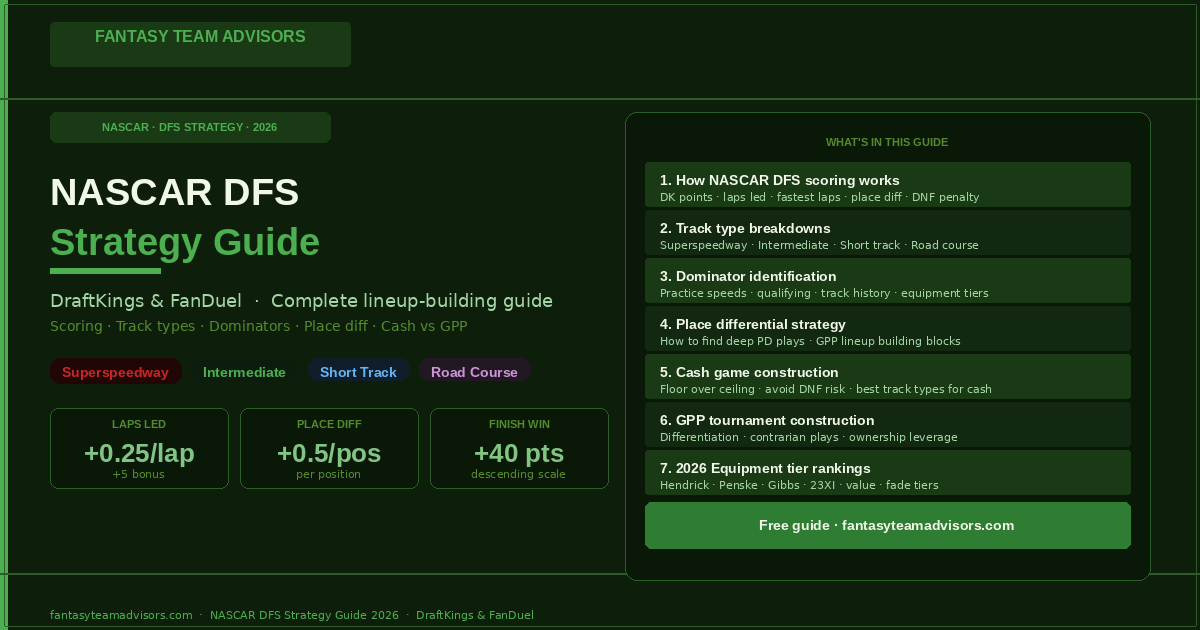
NASCAR DFS Strategy Guide 2026
Everything you need to win at NASCAR daily fantasy on DraftKings and FanDuel — scoring, track types, dominator vs place differential strategy, cash vs GPP construction, and how to use qualifying data.
How NASCAR DFS scoring works
NASCAR DFS on DraftKings scores drivers across four main categories: finishing position, place differential, laps led, and fastest laps. Understanding how each category contributes is essential before you can build consistently winning lineups.
| Category | Points | Notes |
|---|---|---|
| 1st place finish | +40 | Descending scale — 2nd = 35, 3rd = 32… |
| Place differential | +0.5/pos | Per position gained from start to finish |
| Laps led | +0.25/lap | Huge on long races — 100 laps led = +25 pts |
| Most laps led bonus | +5 | Bonus for leading the most laps in the race |
| Fastest laps | +0.1/lap | Additive with laps led — dominators double-dip |
| Most fast laps bonus | +5 | Bonus for posting the most fastest laps |
| DNF penalty | −10 | Significant — avoid DNF-prone drivers |
Track type breakdowns
Track type is the most important contextual factor in NASCAR DFS. Each track type scores differently, produces different DFS value profiles, and requires a completely different lineup building approach.
The most chaotic and unpredictable races. Drafting equalizes speeds — any driver can win. The Big One (massive crash) eliminates favorites and creates massive chaos opportunities.
- Prioritize GPP — cash games are near-impossible to predict
- Target mid-field PD plays starting 20-30th
- Avoid over-priced favorites — chaos is a great equalizer
- Stack drivers who avoid crashes (track record matters)
1.5-mile ovals are the bread-and-butter of the NASCAR schedule. Equipment matters most here — top teams dominate. Lap leaders tend to be predictable, making cash games very winnable.
- Identify the 1-2 likely dominators (Hendrick, Penske, Gibbs)
- Pair dominators with mid-pack value PD plays
- Cash games are very playable — low variance
- Practice speeds are highly predictive here
Under 1 mile. Physical, contact-heavy racing. Cars get damaged, DNFs are common, and passing is difficult. One dominator often leads 300+ laps. High DNF risk punishes cash games.
- Heavy dominator focus — lock in the fastest car
- Avoid drivers with poor short-track history
- DNF risk makes cash games dangerous
- Caution flag count impacts PD plays significantly
Completely different skill set. Road course specialists (SVG, Elliott) dominate. Strategy and tire management replace pure speed. Place differential is massive — expect wild finishing order shuffles.
- Prioritize road course specialists above all else
- Fade oval-only specialists regardless of price
- Massive PD opportunities from chaotic finishing order
- Strategy calls create huge position swings
Dominator strategy
A dominator is a driver expected to lead a significant number of laps. Because laps led scores 0.25 points each plus a 5-point bonus for leading the most laps, a driver who leads 150 of 400 laps scores 37.5 points from laps led alone — before finishing position, fastest laps, or place differential are added.
Identifying the race dominator correctly is worth more than any other single decision in your lineup. At intermediate tracks, one driver typically leads 30-50% of all laps. At short tracks, that number can climb above 60%.
The fastest car in practice at an intermediate track leads most laps 60%+ of the time. Single-lap and 10-lap averages both matter.
Pole sitters lead the opening laps automatically. A fast qualifier who also led practice is your primary dominator target.
Some drivers consistently dominate specific tracks. Kyle Larson at Charlotte, William Byron at Atlanta. Historical laps led data is predictive.
Hendrick Motorsports, Team Penske, Joe Gibbs Racing, and 23XI Racing produce the most dominators. Smaller teams rarely lead significant laps.
Place differential strategy
Place differential (PD) is the difference between a driver’s starting position and finishing position, scored at 1.0 point per position gained on DraftKings and 0.5 on FanDuel. A driver starting 30th and finishing 10th gains 20 positions, worth +20 PD points on DraftKings or +10 on FanDuel. A driver starting 1st and finishing 5th loses 4 positions for −2 points.
The best PD plays are drivers with strong equipment who qualify poorly — they start deep in the field but have the car speed to drive back toward the front. A driver starting 25th with a top-10 car is a prime PD opportunity.
Your ideal NASCAR GPP lineup has 1-2 dominators (starting P1-P5, expensive) paired with 2-3 strong PD plays (starting P20-P32, cheaper). The dominators score on laps led. The PD plays score on position gain. Together they give you a high floor AND a high ceiling.
Qualifying & practice data
Qualifying and practice sessions are your most actionable pre-race data points. DraftKings and FanDuel update salaries after qualifying — meaning starting positions directly affect pricing. Here’s how to use each data point:
Most predictive of dominator potential. The fastest single-lap time indicates which car is fastest outright — key for short tracks and intermediates.
More predictive of race-day performance than single-lap. Simulates long green-flag runs. Best for identifying who will maintain speed over distance.
Sets up PD opportunities. A fast practice car that qualifies poorly (P25+) due to penalties or session issues is a prime PD target.
DraftKings adjusts salaries post-qualifying. A driver who qualified well may be underpriced before the salary update — lock in early.
Cash game construction
Cash games (50/50s, head-to-head, double-ups) reward consistency and floor over ceiling. Your goal is to finish in the top half, not to win outright. This changes the construction approach significantly:
- Target the 1-2 most likely dominators — high floor drivers who start near the front and lead laps regardless of outcome
- Avoid DNF-prone drivers — a DNF at −10 points destroys cash game lineups
- Prioritize equipment quality — top-4 teams (Hendrick, Penske, Gibbs, 23XI) have the highest floors
- Don’t reach for value at the expense of safety — cash games are not the place for 30th-place PD gambles
- Best track types for cash — intermediates and short tracks (more predictable than superspeedways)
- Avoid cash at superspeedways — Daytona and Talladega are GPP-only races due to extreme crash variance
GPP tournament construction
Large-field GPP tournaments require differentiation — you need to win the race, not just cash. The typical winning NASCAR DFS lineup has a unique combination of 1 correct dominator + 2-3 correct PD plays that the field didn’t have.
- 1 lock dominator + 1 contrarian dominator — the chalk dominator anchors the lineup, the contrarian is your differentiator
- 2-3 deep PD plays — drivers starting P20-P32 with top-15 car equipment give you massive upside
- Avoid 100% chalk lineups — a lineup with 6 of the 6 most-owned drivers cannot win a GPP
- Fade an obvious value play everyone is on — a 35%+ owned PD play needs to be off your optimal GPP builds
- Superspeedways = max GPP aggression — roster the 25th-place starter with good equipment and accept the variance
- Road courses = stack specialists — SVG, Elliott, Chastain block-owned in GPP fields, but their ceiling is real
Equipment & team strength
No factor is more important in NASCAR DFS than the car behind the driver. Unlike other sports where individual skill dominates, NASCAR is a team sport — the engine, chassis, and aerodynamic package determine 60-70% of a car’s performance. Here’s the 2026 equipment tier list:
Team Penske (#2, #12, #22)
Joe Gibbs Racing (#11, #19, #20, #54)
RFK Racing (#6, #17)
Richard Childress (#3, #8)
Kaulig Racing
Front Row Motorsports (#34, #38)
Where to play NASCAR DFS
DraftKings is the primary NASCAR DFS platform with the deepest contest selection, largest prize pools, and the most competitive fields. FanDuel offers NASCAR contests with slightly different scoring that rewards finishing position more heavily and reduces the laps-led bonus — making it a bit more predictable for cash games.
For a full comparison of platforms, read our best DFS sites guide for 2026.