NBA Lineup Grader Guide
The NBA Lineup Grader takes one DraftKings or FanDuel lineup and plays it through 2,000 simulations of tonight's slate against a field of 5,000 lineups. It tells you the lineup's average score and range, and how often it beats the double-up line, cashes a tournament, finishes in the top 1 percent and wins outright.
- AccessFree: 3 grades a day. Unlimited grades and swap suggestions with FTA+
- Best forChecking a finished lineup before you enter it, and comparing two versions of the same lineup.
- 1 / 11FTA TOOL GUIDE
How to read the NBA Lineup Grader
Build one lineup and see how often it beats the field
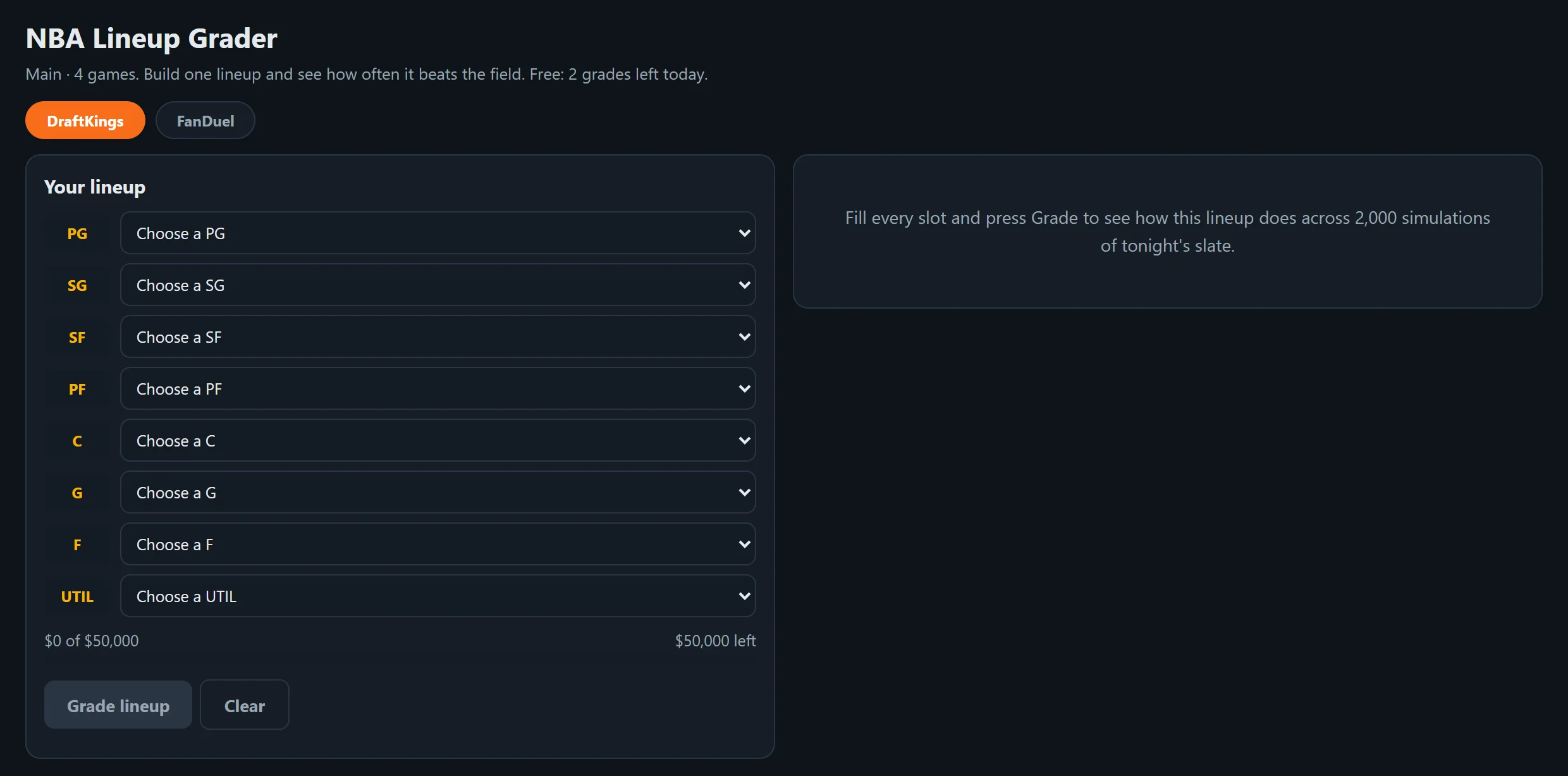 1234
- 1Status line: tonight's slate, and how many free grades you have left today (FTA+ members see unlimited)
- 2Site switch: DraftKings (DK) or FanDuel (FD)
- 3Your lineup: one dropdown per roster spot, the salary bar and the Grade button
- 4Results panel: empty until you grade a lineup
Most tools rate players. This one rates a whole lineup. You pick a player for every roster spot, press Grade, and the grader reports how that exact lineup performs across 2,000 simulated versions of tonight's games.
- 2 / 11YOUR LINEUP
Fill every roster spot
Each dropdown lists only the players who can fill that spot
 12345
- 1Roster spot: on DraftKings the spots are PG, SG, SF, PF, C, G, F and UTIL
- 2A filled spot shows the player, his matchup, salary and projected ownership
- 3Empty spots. G takes a PG or SG, F takes a SF or PF, UTIL takes anyone
- 4Salary line: what you have spent out of the cap, and what is left
- 5Grade lineup stays grey until every spot is filled and you are at or under the cap
Open a dropdown and the players are listed from most expensive to cheapest. Each line shows the player's name, a (Q) if he is questionable, his team and opponent, his salary and his projected ownership. A player you already used in another spot is greyed out, so you cannot pick him twice.
- 3 / 11THE SALARY BAR
Stay under the cap
The bar turns red when you overspend
 12345
- 1Salary used out of the cap ($50,000 on DraftKings, $60,000 on FanDuel)
- 2How much you are over, or how much you have left
- 3The bar is red because this lineup is over the cap
- 4The reason the lineup cannot be graded
- 5Clear empties every spot so you can start again
The bar fills as you add players: green while you are within the salary cap, red once you pass it. An over cap lineup cannot be graded. The message under the buttons tells you why the Grade button is off.
- 4 / 11THE GRADE
Average score and range
What this lineup scores on a normal night, a bad night and a good night
 123
- 1Average score: the lineup's mean fantasy points across the 2,000 simulations
- 210th to 90th: the range its score lands in 8 times out of 10
- 3The status line counts down your free grades after each one
Press Grade lineup and the results panel fills in. The first two tiles describe the lineup's own scoring. The range runs from the 10th percentile (a bad night: it scores less than this 1 time in 10) to the 90th (a good night: it beats this 1 time in 10). A wide range means a volatile lineup.
- 5 / 11THE GRADE
Four chances, from safest to hardest
How often this lineup clears each finish line against the field
 1234
- 1Beats the double-up line: how often it beats 45 percent of the field. This is the cash game number
- 2Cashes a tournament: how often it finishes in the top 20 percent, a typical tournament cash line
- 3Finishes top 1%: how often it reaches the big payouts
- 4First of 5,000: how often it has the top score in a 5,000 entry field
In every simulation the grader scores your lineup and a field of 5,000 lineups built the way the public builds them, then checks where yours finished. The four tiles are how often it cleared each bar. Read the first one for cash games and the last two for tournaments.
TipThe tournament numbers are small for every lineup. An average lineup lands in the top 1 percent about 1 time in 100 by definition, so a figure several times higher than 1% is a strong tournament lineup.
- 6 / 11THE GRADE
Salary used and total ownership
Two facts about the lineup itself
 123
- 1Salary used: what the lineup costs. Money left unspent is not always a mistake, but check that you meant it
- 2Total ownership: the sum of every player's projected ownership
- 3Free visitors see an FTA+ box here. Members see Best single swaps in this spot (next slide)
Total ownership adds up the projected ownership of every player in the lineup. A high total means a chalky lineup, one built from popular players. That is fine for cash games. In a large tournament a very popular lineup has to share its good nights with a lot of similar lineups.
- 8 / 11THE FINE PRINT
What the grade is measuring
The note under the tool explains the method
 1
- 1Each grade adds your players' scores in each of 2,000 simulations, with players on the same team and in the same game moving together, and compares the total with a field of 5,000 lineups in that same simulation
Two details matter. Teammates and opponents move together in the sims, so a lineup stacked on one game has a wider range than one spread across the slate. And the field is built the way the public builds lineups, so popular players are in many of the lineups you are compared against.
- 9 / 11FANDUEL
Grade a FanDuel lineup
Different roster spots, salaries and cap
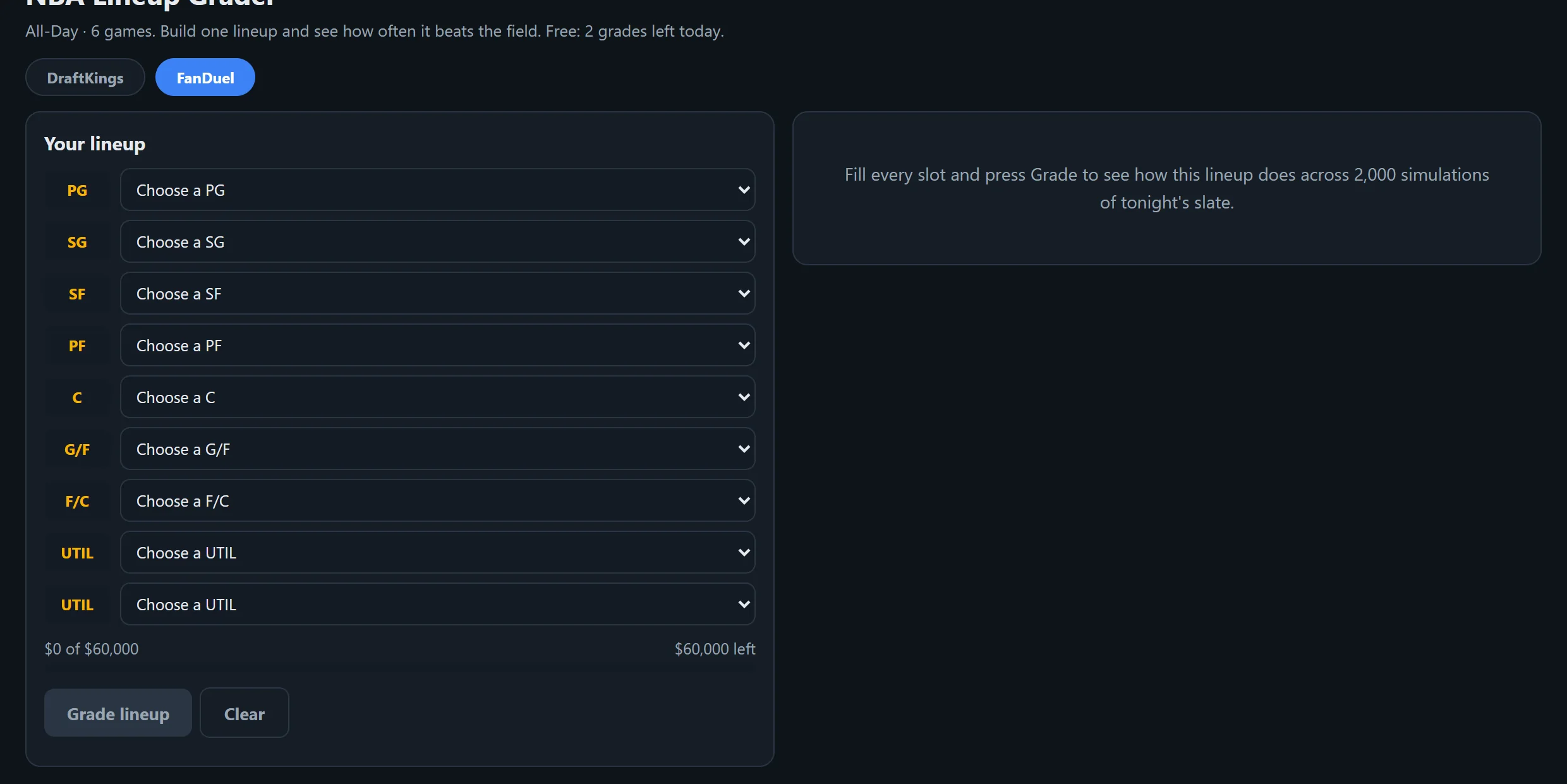 123
- 1FanDuel is on (blue)
- 2FanDuel roster spots as the tool lists them: PG, SG, SF, PF, C, G/F, F/C and two UTIL
- 3The cap reads $60,000
Click FanDuel and the builder switches to FanDuel's slate, salaries, ownership and roster spots, with a $60,000 cap. Each site keeps its own lineup, so you can switch back and forth without losing your picks.
- 10 / 11FREE AND FTA+
What you get free and with FTA+
Three free grades a day. FTA+ removes the limit and adds swaps
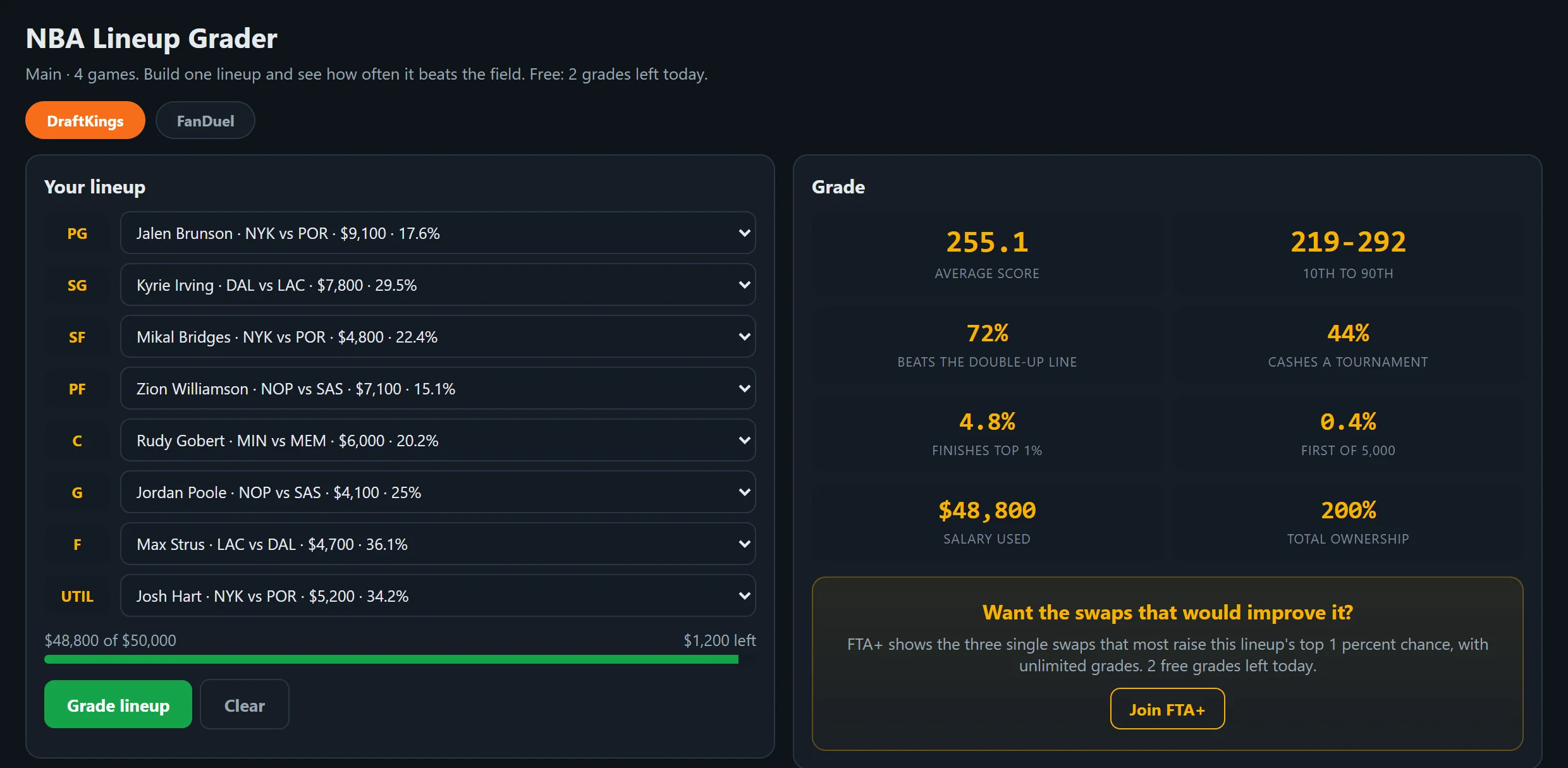 123
- 1The free grade counter
- 2Free: the full grade, every tile
- 3FTA+: the three single swaps that most raise the top 1 percent chance, and unlimited grades
Anyone can build a lineup and grade it three times a day, on either site, with all eight result tiles. After the third grade the results panel shows a box saying the day's free grades are used. FTA+ members get unlimited grades and the Best single swaps list under each one.
NBA Lineup Grader glossary
- Simulation
- One played out version of tonight's slate, with a fantasy score for every player. The grader uses 2,000 of them.
- Field
- The other lineups in a contest. The grader compares yours with 5,000 lineups built the way the public builds them.
- Average score
- The lineup's mean fantasy points across all simulations.
- 10th to 90th
- The range the lineup's score falls in 8 times out of 10.
- Double-up line
- Beating 45 percent of the field, the bar for winning a double-up style cash game.
- Cashes a tournament
- Finishing in the top 20 percent, a typical tournament cash line.
- Top 1%
- Finishing in the top 1 percent of the field, where the large tournament payouts are.
- First of 5,000
- Having the top score in a 5,000 entry field.
- Salary cap
- The most you can spend on a lineup: $50,000 on DraftKings and $60,000 on FanDuel.
- Total ownership
- The projected ownership of every player in the lineup, added together.
- Chalk
- Popular players. A chalky lineup is one with high total ownership.
- G, F, UTIL
- Flexible roster spots. On DraftKings G takes a guard (PG or SG), F takes a forward (SF or PF) and UTIL takes any player.
- Swap
- Replacing one player in the lineup with another who fits the same spot.
- (Q)
- Questionable: the player may not play.
NBA Lineup Grader questions
Is the Lineup Grader free?
Yes, for three grades a day. FTA+ members get unlimited grades and the three best single swaps under each grade.
What is a good grade?
For cash games, look for a double-up number well above 50%. For tournaments, compare the top 1% figure with 1%, which is what an average lineup gets. Several times that is strong.
Why is my first place chance so small?
It is the chance of beating 5,000 other lineups outright. Even very good lineups win a field that size rarely.
Can I grade a lineup for a different slate?
The grader uses the slate named in the status line under the title for each site. Players outside that slate are not in the dropdowns.
Does it tell me who to play?
It grades the lineup you give it. FTA+ members also get the single swaps that would most improve its top 1 percent chance.