NFL Advanced Stats Guide
NFL Advanced Stats is three sortable boards, one each for quarterbacks, running backs and pass catchers. They go past yards and touchdowns to show how a player earns his numbers: efficiency, depth of target, share of the offense and what he does after contact. Use them to tell real skill and real opportunity from a lucky stretch.
- AccessFree preview. Full boards with FTA+
- Best forChecking whether a player's production is likely to hold, for DFS, props and season-long trades.
- 1 / 13FTA+ TOOL GUIDE
How to read NFL Advanced Stats
Three boards with one design: QB, RB and Receiving
 1234
- 1Title: the board and the season, with a reminder that any column can be sorted
- 2Board tabs: QB, RB and Receiving. The green one is on screen
- 3Search: type part of a player's name, or a team abbreviation
- 4Column headers: click one to sort. The sorted header and its numbers turn gold
Each page opens on its own position, and the tabs let you jump to the other two without leaving. Every board lists season totals and rates for the players who have enough volume to judge, opening with the highest fantasy scorers on top.
- 2 / 13QUARTERBACKS, PART 1
QB board: volume and production
Who he is, how much he scores and the standard passing line
 1234
- 1#, Player, Tm and G: rank in the current sort, the player, his team and games played
- 2PPG: fantasy points per game. Every board opens sorted by this column
- 3Att, Cmp%, Yds and Y/A: pass attempts, completion percentage, passing yards and yards per attempt. Above 8 yards per attempt is excellent, under 6.5 is poor
- 4TD and INT: touchdown passes and interceptions
Start on the left. PPG tells you what the player has been worth for fantasy. The passing line tells you how he got there: lots of attempts, efficient yards per throw, or touchdowns.
- 3 / 13QUARTERBACKS, PART 2
QB board: aDOT, EPA and CPOE
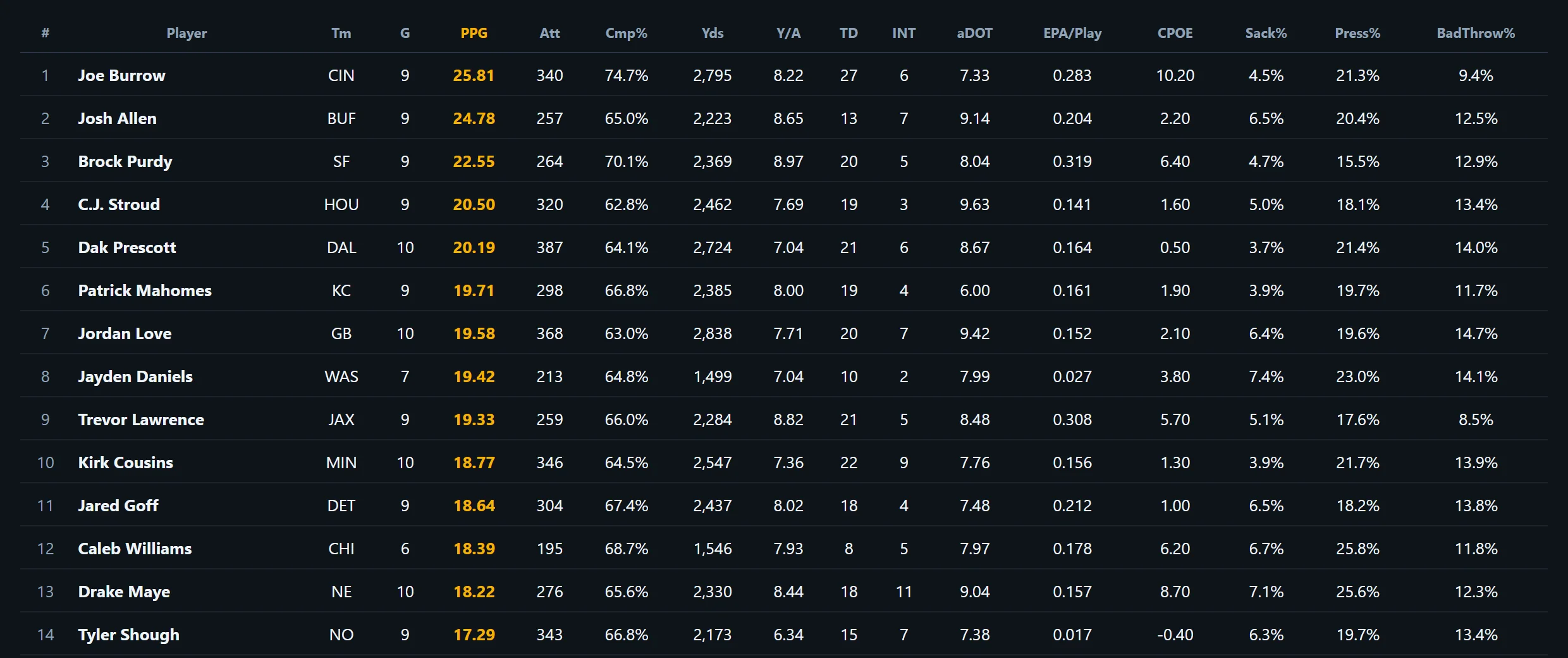
Three numbers that describe how well and how aggressively he throws
 123
- 1aDOT: average depth of target, in yards past the line of scrimmage. High means he pushes the ball downfield, which raises the ceiling for his receivers. Low means short, safe throws
- 2EPA/Play: expected points added per dropback. It measures how much each play improved his team's chance to score. Positive is good. Above 0.15 is among the league's best
- 3CPOE: completion percentage over expected, adjusted for how hard the throws were. Plus 3 or better is a very accurate passer. Negative means he misses throws an average passer makes
These columns separate a quarterback who is playing well from one who is piling up numbers on volume. EPA and CPOE both sit near zero for an average passer. Positive is better than average and negative is worse.
TipFor tournaments, a high aDOT quarterback with a positive EPA gives you the big plays that win. For cash games, favor a positive CPOE: accuracy is steadier week to week.
- 4 / 13QUARTERBACKS, PART 3
QB board: sacks, pressure and bad throws
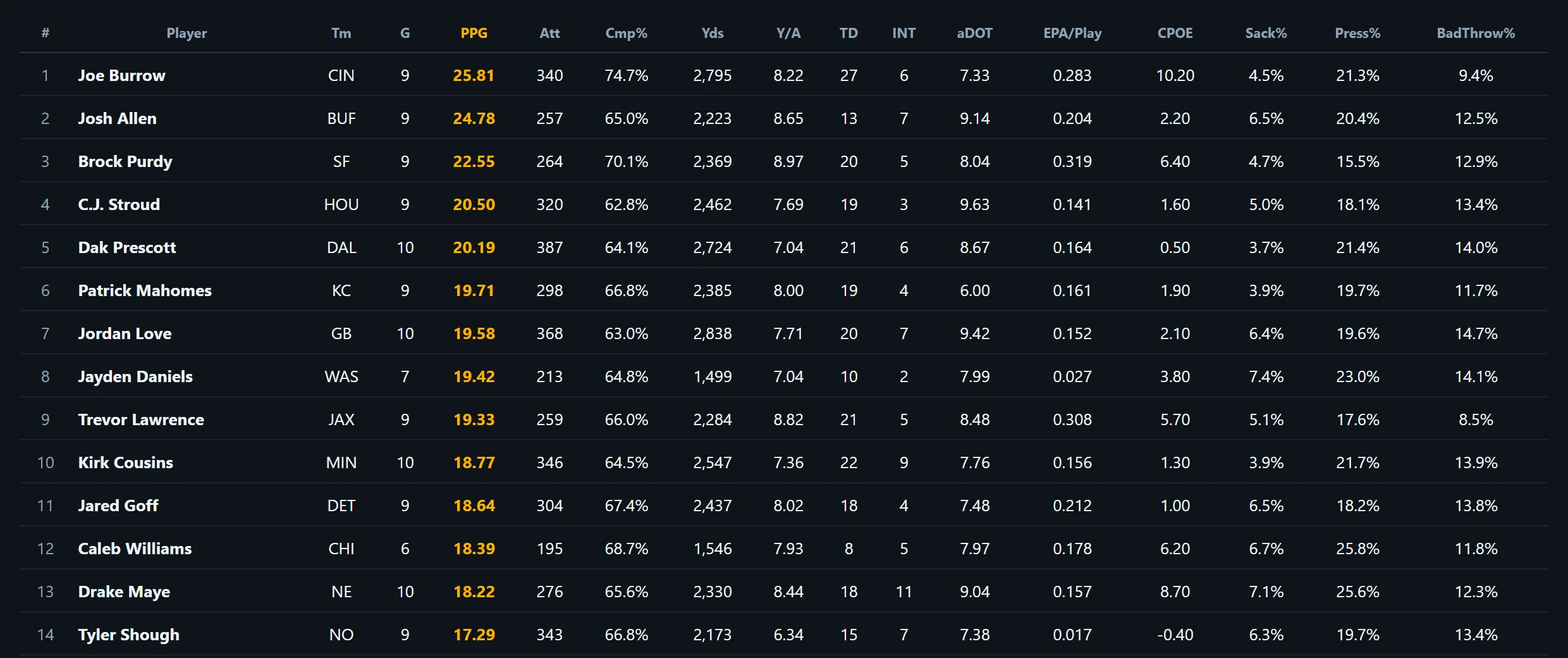
The three columns where low is good
 123
- 1Sack%: the share of his dropbacks that end in a sack. Lower is better
- 2Press%: the share of his dropbacks on which he is pressured. This reflects his line as much as him
- 3BadThrow%: the share of his throws charted as off target. Lower is better for him and for every receiver he throws to
These are the warning lights. A quarterback who is pressured often and takes sacks loses drives, and a high bad throw rate means the receivers are leaving points on the field. Sort these and read from the bottom for the cleanest passers.
TipHigh Press% with low Sack% is a quarterback who escapes trouble. High in both is a problem that follows him into bad matchups.
- 5 / 13RUNNING BACKS, PART 1
RB board: carries, yards and EPA per rush
The rushing line and how much each carry helped
 12345
- 1The RB tab is lit. This is the board the running back page opens on
- 2PPG: fantasy points per game, the opening sort
- 3Car, Rush Yds and Y/C: carries, rushing yards and yards per carry. Above 4.5 per carry is strong, under 3.8 is weak
- 4TD and 1D: rushing touchdowns and first downs gained on the ground
- 5EPA/Rush: expected points added per carry. Most backs sit near or just below zero, so any positive number is good
Carries are the opportunity and yards per carry is the result. EPA per rush adds context that yards per carry misses: a 3 yard run on third and 2 is a good play, and a 6 yard run on third and 10 is not.
- 6 / 13RUNNING BACKS, PART 2
RB board: line help, broken tackles and catches
What the blocking gave him, what he made himself, and his passing game role
 1234
- 1YBC/Att: yards before contact per carry. How far he gets before a defender touches him. High points to good blocking
- 2YAC/Att: yards after contact per carry. What he adds on his own. Higher is better
- 3Brk Tkl and Att/Brk: broken tackles, and carries per broken tackle. For Att/Brk a lower number is better, because he breaks one more often
- 4Tgt and Rec Yds: targets and receiving yards. Backs who catch passes have a higher floor, most of all on DraftKings where a catch is a full point
Yards before contact are mostly the offensive line. Yards after contact and broken tackles are the runner. A back with low yards before contact and high yards after contact is better than his line, and would gain from a softer matchup or healthier blockers.
- 7 / 13RECEIVING, PART 1
Receiving board: targets, catches and yards
Wide receivers, tight ends and backs who qualify, on one board
 12345
- 1The Receiving tab is lit. This is the board the receiving page opens on
- 2Pos: WR, TE or RB
- 3PPG: fantasy points per game, the opening sort
- 4Tgt, Rec and Catch%: targets, receptions and the share of targets caught
- 5Yds, Y/R and TD: receiving yards, yards per reception and touchdown catches
The receiving board adds a Pos column because it mixes positions. Targets are the opportunity. Catch rate and yards per catch tell you what kind of receiver he is: a high catch rate with low yards per catch is a short-area target, and the reverse is a deep threat.
- 8 / 13RECEIVING, PART 2
Receiving board: share of the offense
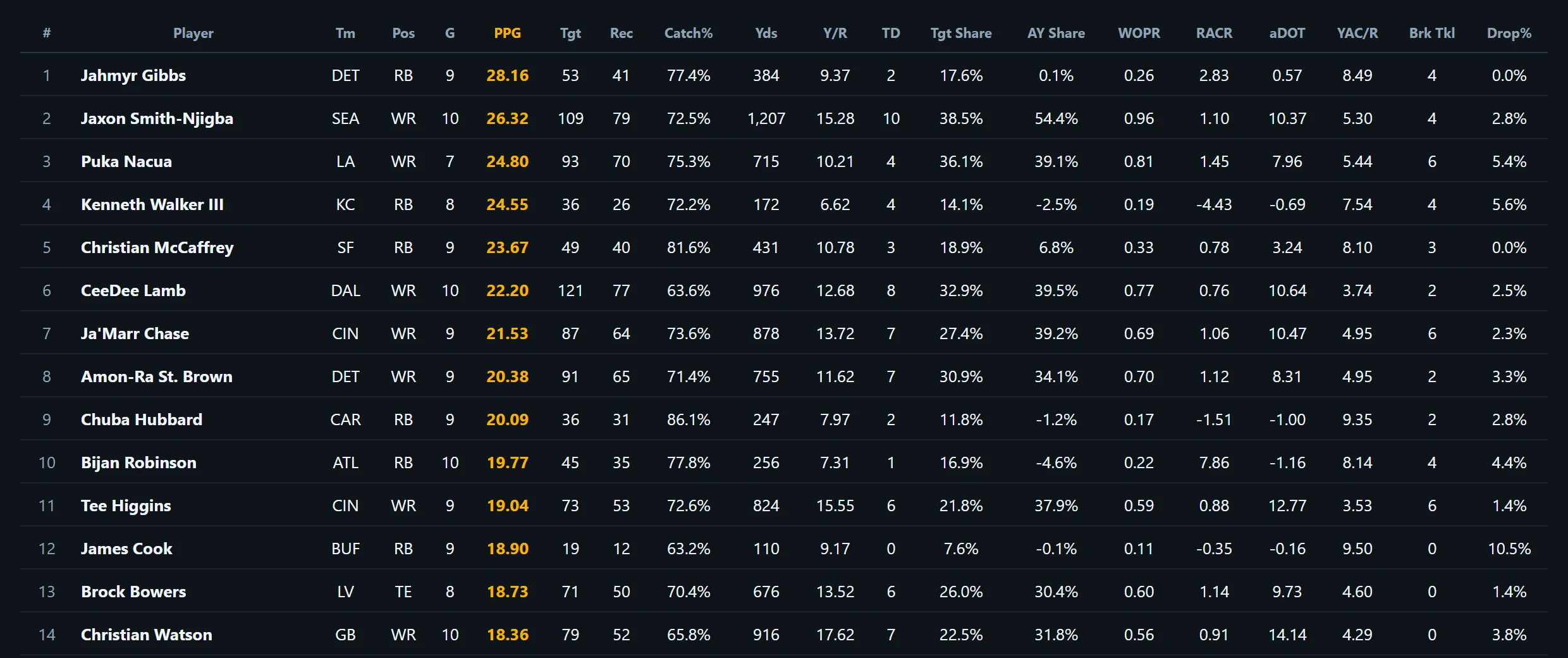
Tgt Share, AY Share, WOPR and RACR
 1234
- 1Tgt Share: his share of his team's targets. 25% and up is a true number one option
- 2AY Share: his share of his team's air yards, the distance the ball travels in the air on targets. 35% and up means he owns the downfield work
- 3WOPR: weighted opportunity rating, target share and air yards share combined. Above 0.60 is strong, above 0.70 is elite
- 4RACR: receiver air conversion ratio, receiving yards divided by air yards. Near 1.0 means he turns his air yards into real yards. Well above 1.0 is a short-area player who runs after the catch
These four columns are the heart of the board. The first three measure how much of his team's passing game belongs to him, which is the most stable thing about a receiver. RACR then tells you how much of that opportunity he turned into yards.
TipA high WOPR with a low RACR and a modest PPG is the classic buy: the opportunity is there and the results have not arrived yet.
- 9 / 13RECEIVING, PART 3
Receiving board: depth, run after catch and drops
aDOT, YAC/R, Brk Tkl and Drop%
 1234
- 1aDOT: average depth of target. 13 yards and up is a deep threat, 8 to 12 is a typical outside receiver, under 7 is a slot or tight end role
- 2YAC/R: yards after the catch per reception. Higher means he creates his own yards
- 3Brk Tkl: tackles broken after the catch
- 4Drop%: the share of his targets that he dropped. Lower is better. A high drop rate can cost a player targets over time
The last group tells you how a receiver wins. Deep targets bring volatility: fewer catches, bigger plays. Run after catch ability brings a steadier floor, because short passes are completed more often.
TipOn this board YAC means yards after the catch. On the RB board it means yards after contact. Same letters, different stat.
- 10 / 13SORTING AND SEARCH
Re-rank the board by any stat
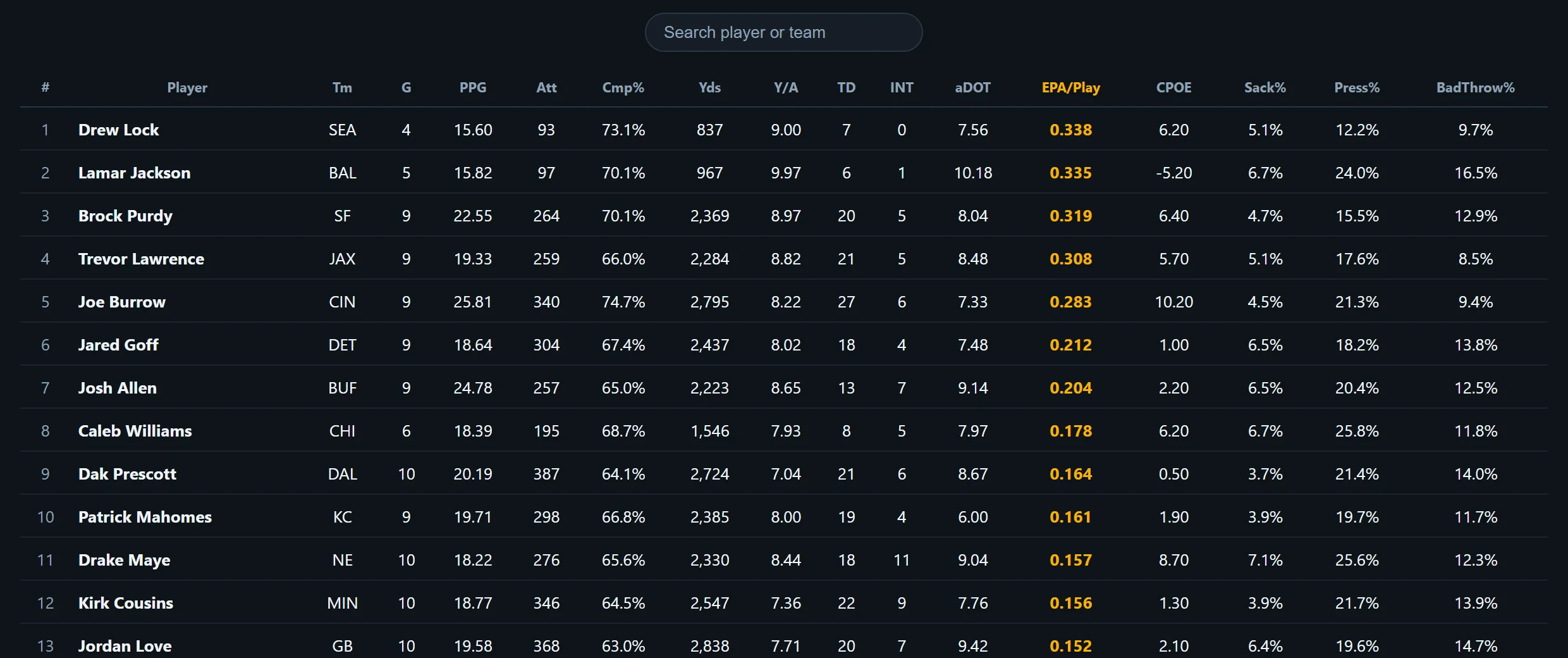
Click a header to sort. Type to filter
 123
- 1Search: a player's name works with any part of it. For a team, type the exact abbreviation used in the Tm column
- 2The gold header and gold numbers show the current sort, here EPA per play with the best on top
- 3Check G and the volume column when a surprise name tops a rate stat. Fewer games means a shakier number
The first click sorts highest first, and a second click flips it. The sorted column's numbers turn gold so you can read down it quickly. For stats where low is good, such as Sack%, BadThrow%, Att/Brk and Drop%, click twice.
- 11 / 13BELOW THE TABLE
Minimums, the CSV and the built-in glossary
Three things under every board
 123
- 1The count line: how many players are shown, and the minimum attempts, carries or targets and games needed to qualify
- 2Download CSV (FTA+): saves the board on screen, in its current sort and search, as a spreadsheet
- 3Glossary box: short definitions of EPA, CPOE, aDOT, WOPR, RACR, YBC and YAC, on the page whenever you need them
Players need a minimum workload to appear, so a backup with one long run cannot top a rate stat. The minimum grows through the season and is printed under the table. If a player is missing, he has not reached it yet.
- 12 / 13FREE PREVIEW
What you get free and with FTA+
Everyone sees a 15 player preview of each board. Members get every qualified player
 12
- 1The count line. In the free view it counts only the preview rows, so it reads 15 of 15
- 2The gold box marks the end of the free preview, with the link to join FTA+ for the full board and the CSV
The free view loads a 15 player preview of each of the three boards, with every column. You can still sort those 15 by any stat and search within them. FTA+ loads every qualified player and adds the CSV download.
NFL Advanced Stats glossary
- PPG
- Fantasy points per game. The column every board opens sorted by.
- G
- Games played.
- Att / Cmp%
- Pass attempts, and the percentage of them completed.
- Y/A
- Passing yards per attempt. A quick measure of passing efficiency. Higher is better.
- INT
- Interceptions thrown. Lower is better.
- EPA
- Expected points added. Every play changes how many points a team can expect to score on that drive. EPA is that change, credited to the player. EPA/Play is per dropback for quarterbacks and EPA/Rush is per carry for running backs. Positive is good, negative is bad.
- CPOE
- Completion percentage over expected, adjusted for throw difficulty. Positive means he completes more passes than an average quarterback would on the same throws.
- aDOT
- Average depth of target, in yards past the line of scrimmage. High means deep throws and big-play upside. Low means short, high-percentage throws.
- Sack%
- The share of a quarterback's dropbacks that end in a sack. Lower is better.
- Press%
- The share of a quarterback's dropbacks on which he is pressured. Lower is better.
- BadThrow%
- The share of a quarterback's throws charted as off target. Lower is better.
- Car / Y/C
- Carries, and rushing yards per carry.
- 1D
- Rushing first downs.
- YBC/Att
- Yards before contact per carry: how far the runner gets before a defender touches him. Mostly a measure of blocking.
- YAC/Att
- Yards after contact per carry: what a runner gains after the first hit. A measure of the runner himself.
- Brk Tkl
- Broken tackles.
- Att/Brk
- Carries per broken tackle. Lower is better, because it means he breaks tackles more often.
- Tgt / Rec
- Targets (passes thrown to him) and receptions (passes caught).
- Catch%
- The share of his targets that he caught.
- Y/R
- Receiving yards per reception.
- Tgt Share
- His share of his team's targets. The steadiest measure of a receiver's role.
- AY Share
- His share of his team's air yards. Air yards are the distance the ball travels in the air on targets, caught or not.
- WOPR
- Weighted opportunity rating: target share and air yards share combined into one number. Higher means he owns more of the passing game.
- RACR
- Receiver air conversion ratio: receiving yards divided by air yards. It shows how well he turns opportunity into yards.
- YAC/R
- Yards after the catch per reception.
- Drop%
- The share of his targets that he dropped. Lower is better.
NFL Advanced Stats questions
Why is a player missing from a board?
Each board has a minimum workload (pass attempts, carries or targets, plus games played) that grows as the season goes on. The current minimum is printed under the table. Players below it are left off so small samples do not top the rate stats.
What is the single most useful column?
For quarterbacks, EPA/Play. For running backs, YAC/Att alongside carries. For pass catchers, WOPR. Each one captures the thing that best carries forward at that position.
What does a negative EPA or CPOE mean?
Below average. Zero is roughly a league average play or passer, so a negative number means the player has cost his offense compared with that baseline.
Is this page free?
A 15 player preview of each board is free, with every column and sorting. FTA+ opens every qualified player and the CSV download.
Are the three pages different tools?
No. They are the same tool opened on a different tab. You can reach all three boards from any of the pages.